Adding & editing hosts
The SSH editor lets you choose where a new host lives:
- Muxus app data only keeps a self-contained SSH profile in the local database and
does not change
~/.ssh/config. - OpenSSH config writes a standard
Hostblock that also works withssh,scpandrsyncoutside Muxus.
Presentation attributes such as folder, colour, highlighting and logging policy always live in the Muxus database.
Open the editor with + at the top of the sidebar, from a host's Edit host menu entry, or by pressing Enter on a search that matched nothing.
What a save rewrites
This applies only to hosts stored in OpenSSH config. Saving rewrites only that block.
Comments, ordering, Match blocks and every other
host in the file are left untouched. The write is atomic, and the previous contents are
kept next to it as <file>.muxus.bak.
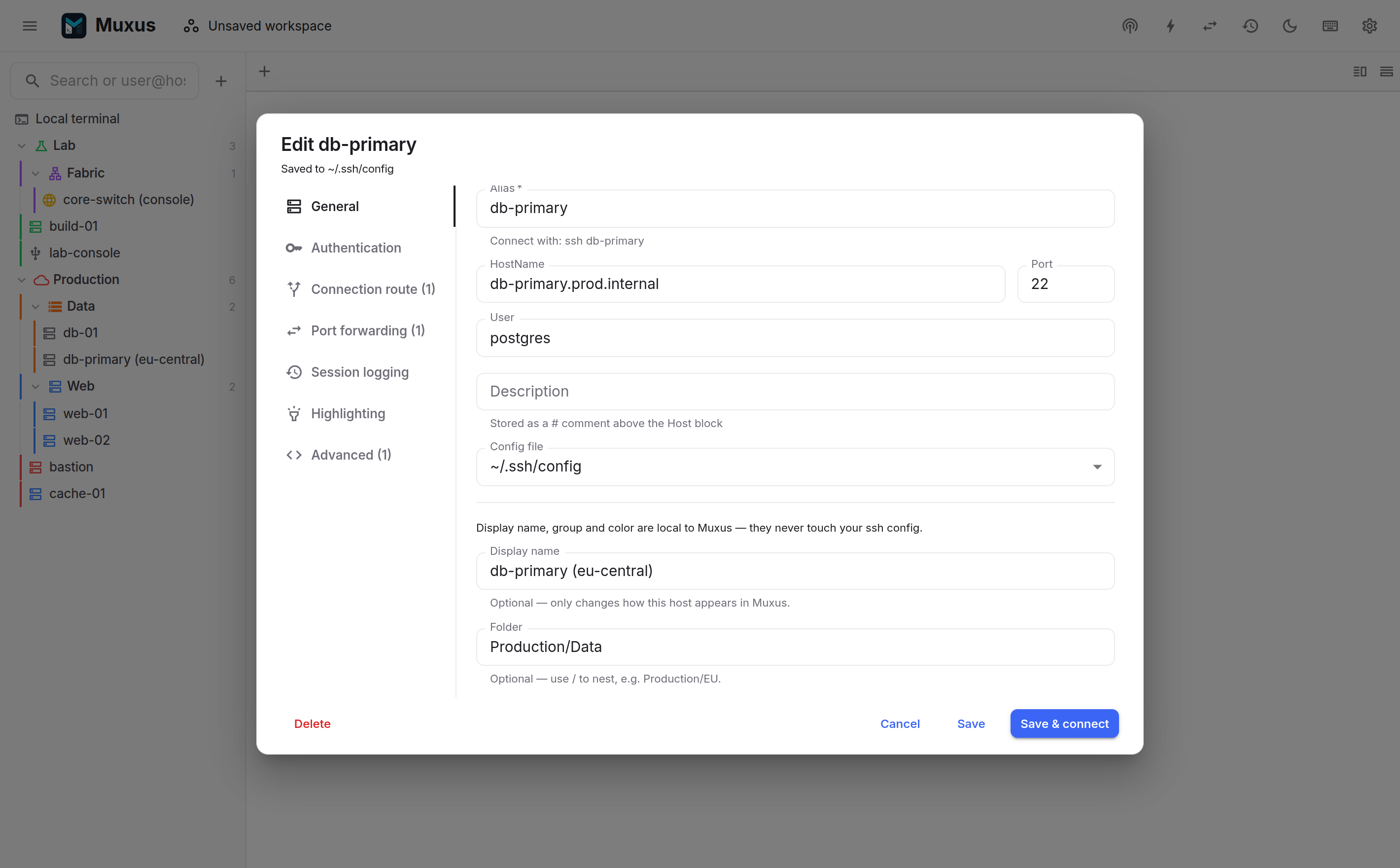
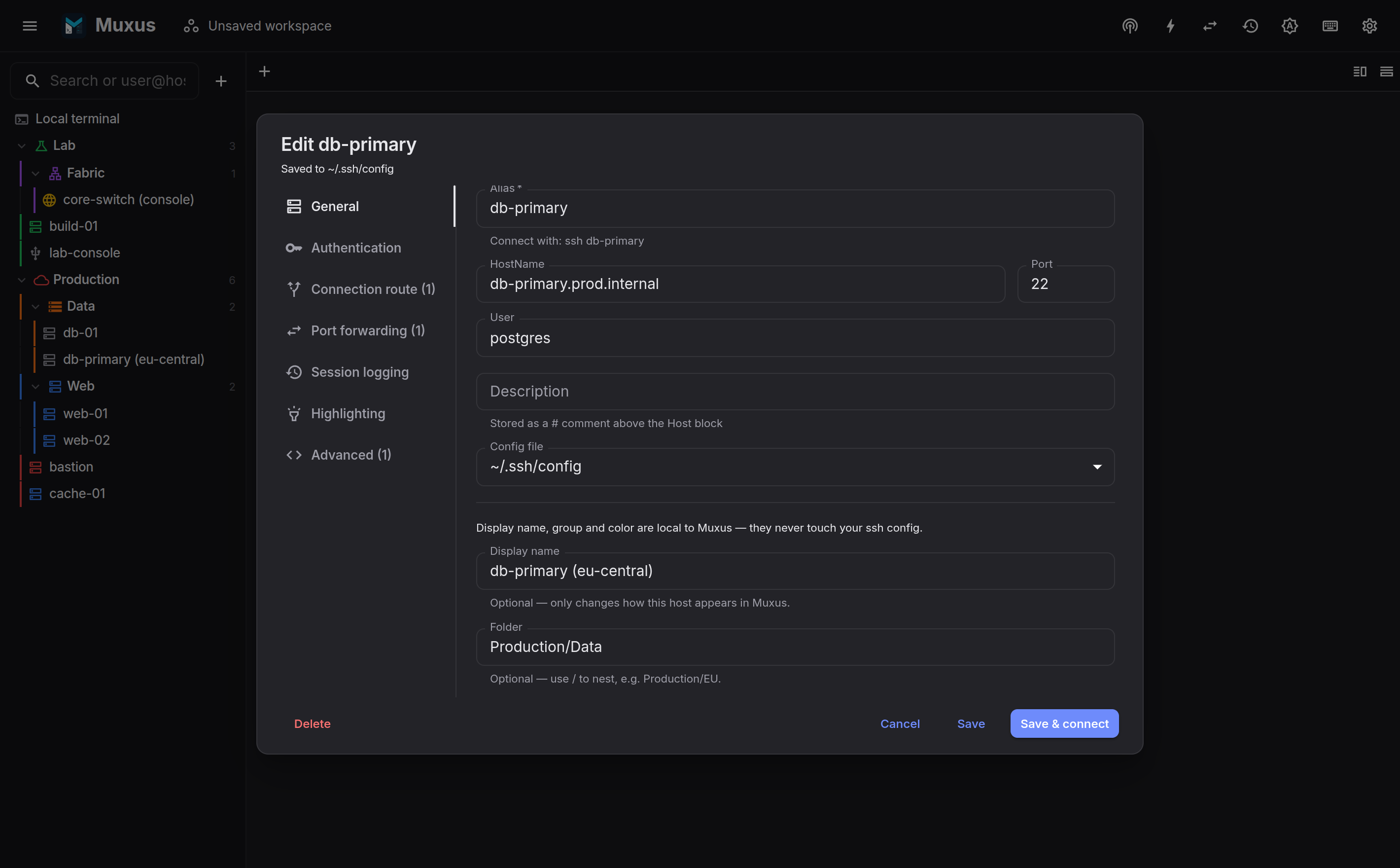
General
| Field | Writes |
|---|---|
| Save host in | Selects Muxus app data or an OpenSSH configuration file for a new SSH host. |
| Alias | The Host line. Several aliases separated by spaces are accepted; the first one names the session. |
| HostName | HostName. Empty means the alias is used as the hostname, as in OpenSSH. |
| Port | Port, omitted when it is 22. |
| User | User, omitted to use the local username. |
| Description | A # comment above the block, shown in the sidebar's hover card. |
| Config file | Which file the block lands in: the main config, an existing Included file, or a new group file that Muxus creates and includes. |
| Display name, folder, colour | Muxus's own database, not the configuration file. |
Authentication
Three modes, matching OpenSSH behaviour:
- Agent & default keys uses the OpenSSH order: agent first, then
~/.ssh/id_*. Writes nothing, since this is the default. - Specific key file writes
IdentityFileandIdentitiesOnly yes, so login uses only the selected files and never waits on the agent. The picker lists the keys found in~/.sshwith their type and comment, badges the ones loaded in the agent, and marks the ones that are passphrase-protected. - Password / interactive writes
PubkeyAuthentication no, so public keys are skipped and a prompt is issued on connect.
User certificates can be added separately as CertificateFile, for CA-signed keys.
Connection route
The route determines how the connection is dialled.
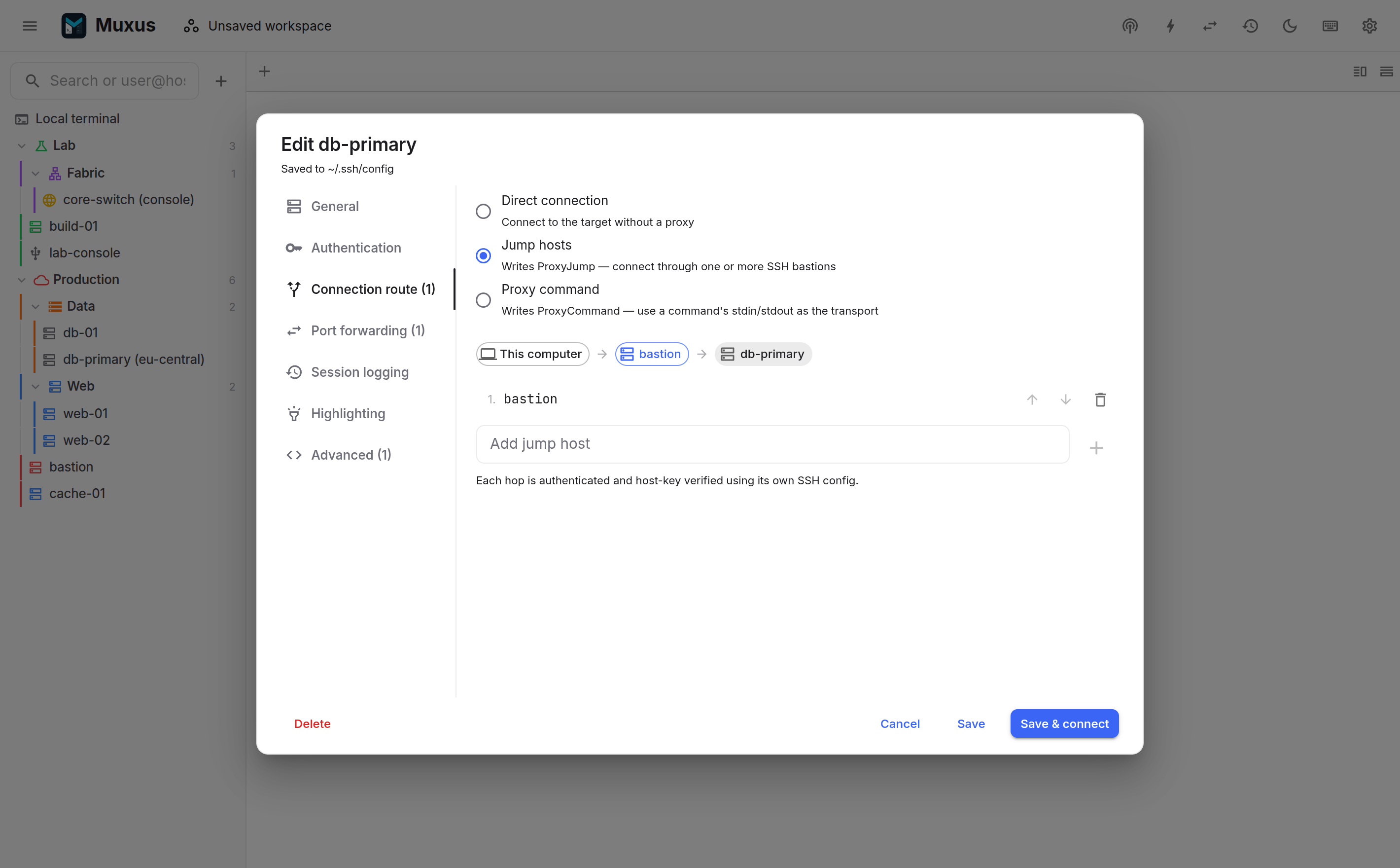
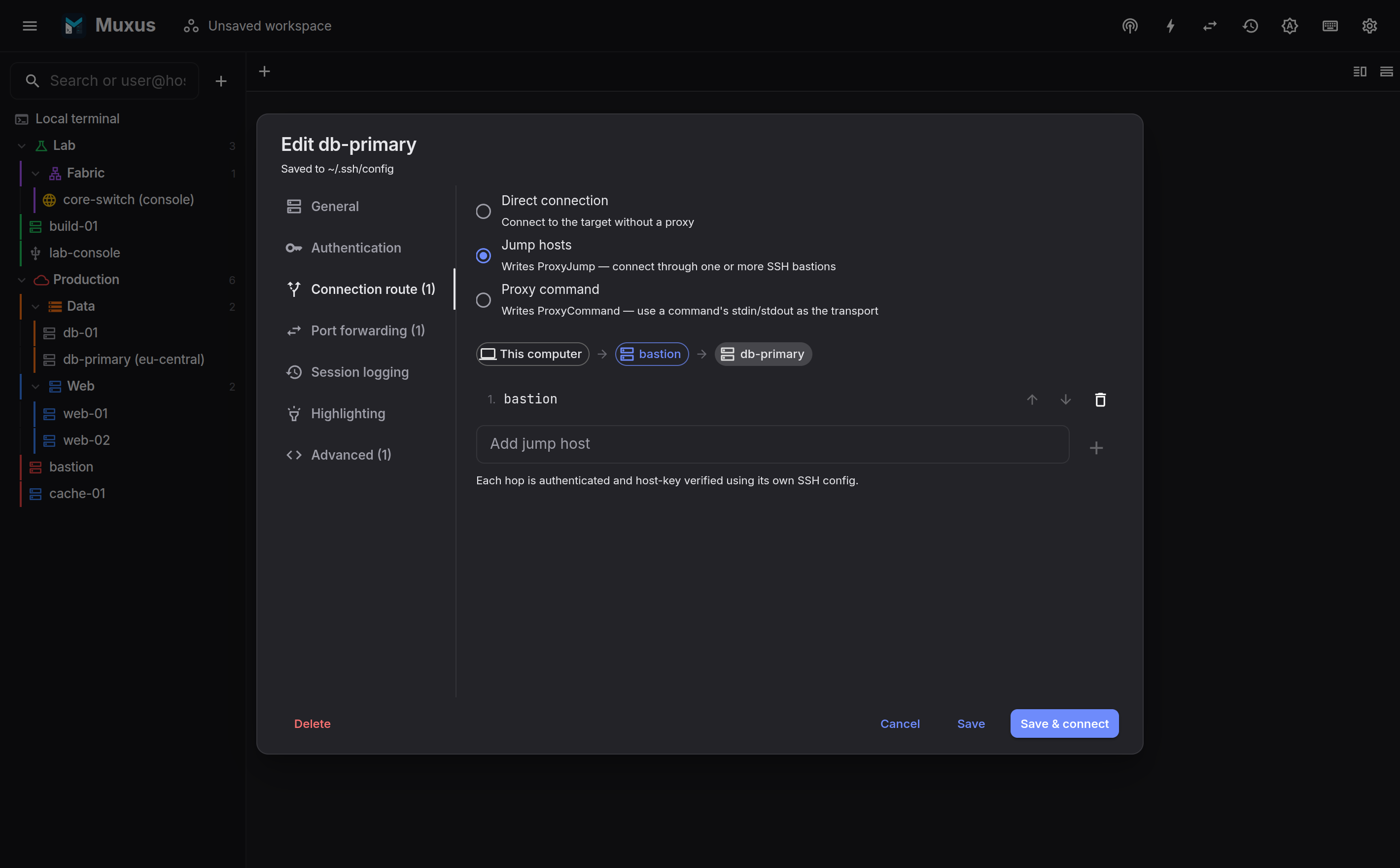
- Direct writes nothing.
- Jump hosts writes the chain, in order, as
ProxyJump a,b,c. Each hop is either an alias from the configuration or a bareuser@host:port. Muxus dials the hops in sequence and rejects a chain that loops back on itself. - ProxyCommand takes a command that provides the transport on stdin/stdout, such as
cloudflared access ssh --hostname %h. The%h,%pand%rtokens are expanded at dial time.
More on how connections are made
Port forwarding
Forwards declared here are written into the block as LocalForward, RemoteForward or
DynamicForward, and start with every session to this host.
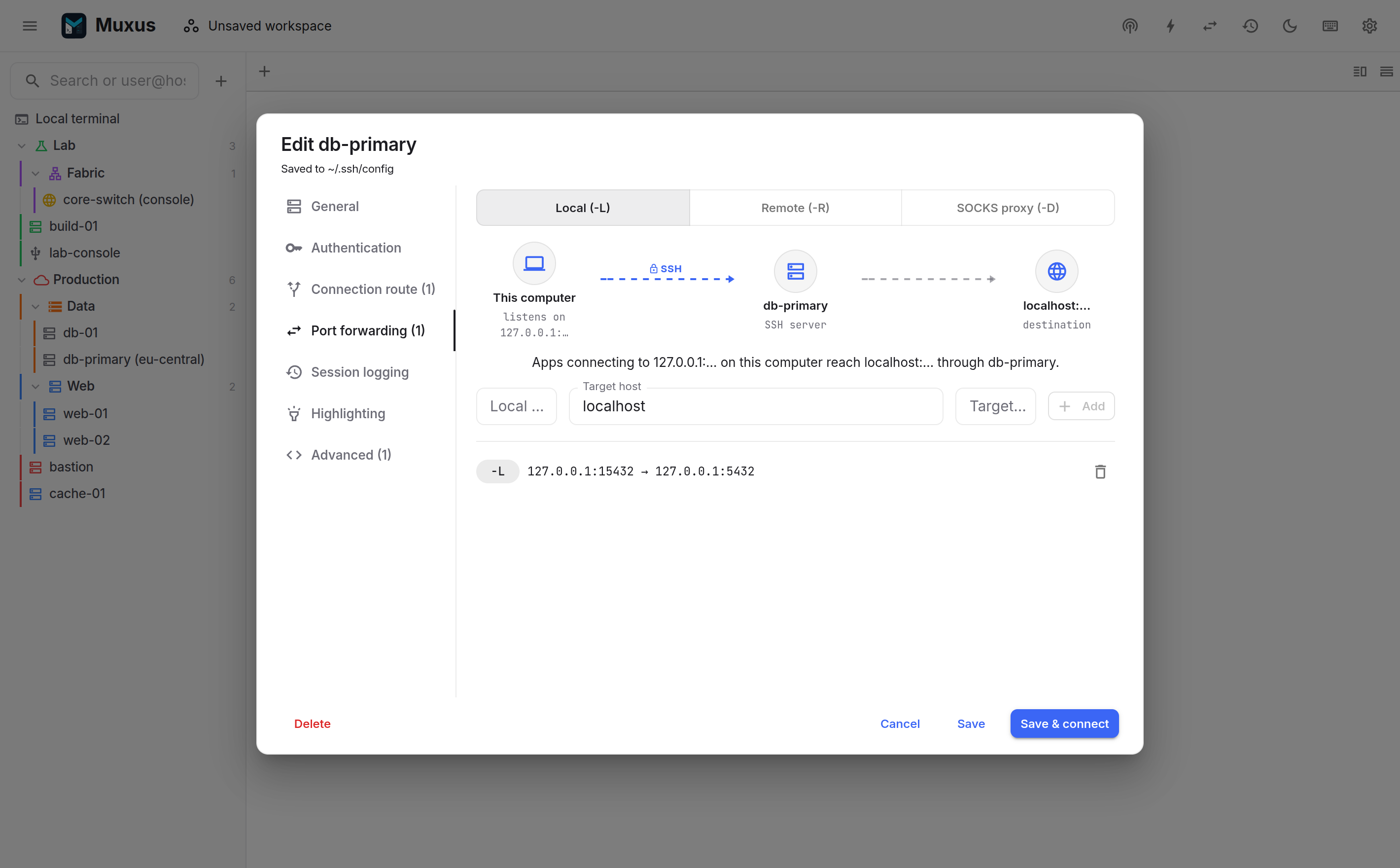
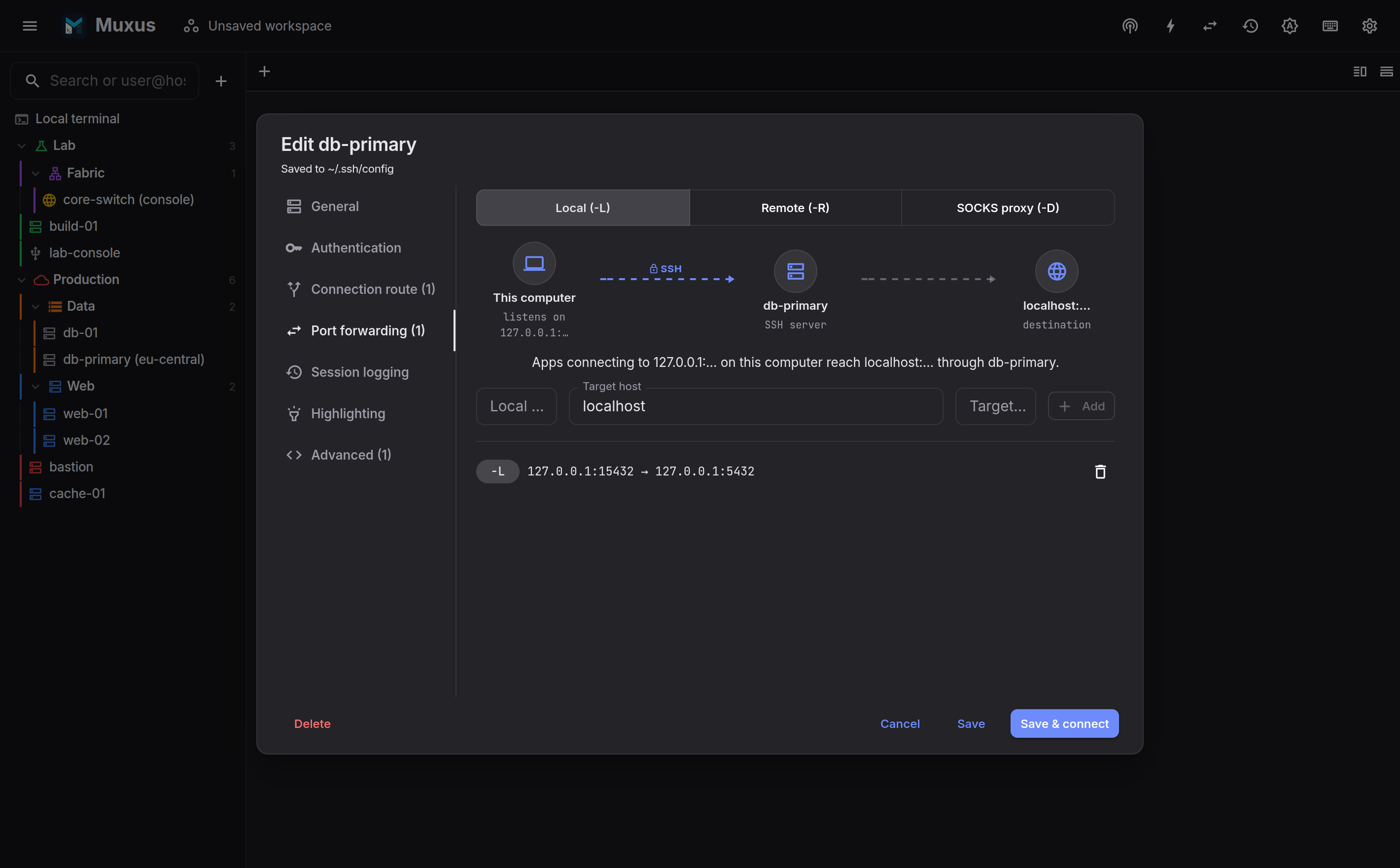
To start a forward on demand instead, without opening a terminal, save it as a tunnel.
Session logging & highlighting
Two per-host overrides of the global settings:
- Session logging inherits the global policy, or forces retention on or off for this host, including whether keystrokes are recorded.
- Highlighting adds keyword rules for this host's terminals, either in addition to or instead of the global rules.
Advanced
Muxus does not request SFTP unless its initial probe identifies a supported Unix shell. If a console server disconnects when it sees even that probe, Muxus reconnects once in plain-console mode and remembers the compatibility choice until the app restarts. No manual setting is required for the session to connect.
For known-sensitive SSH console servers and network appliances, Enable console compatibility
mode skips the initial probe as well, and stops sending SendEnv/SetEnv values that these
devices have no environment for. This persistent override avoids the first reconnect entirely.
Terminal allocation follows the host's TTY setting either way: Muxus asks for a terminal and
continues without one when the device rejects pty-req. The file-browser controls are unavailable
for plain-console sessions.
For an otherwise normal SSH server that only lacks SFTP or cannot use Muxus shell integration, Disable SFTP and shell integration only keeps environment requests and normal terminal allocation intact. This remains separate from console compatibility so existing disabled-SFTP hosts keep their previous session behavior.
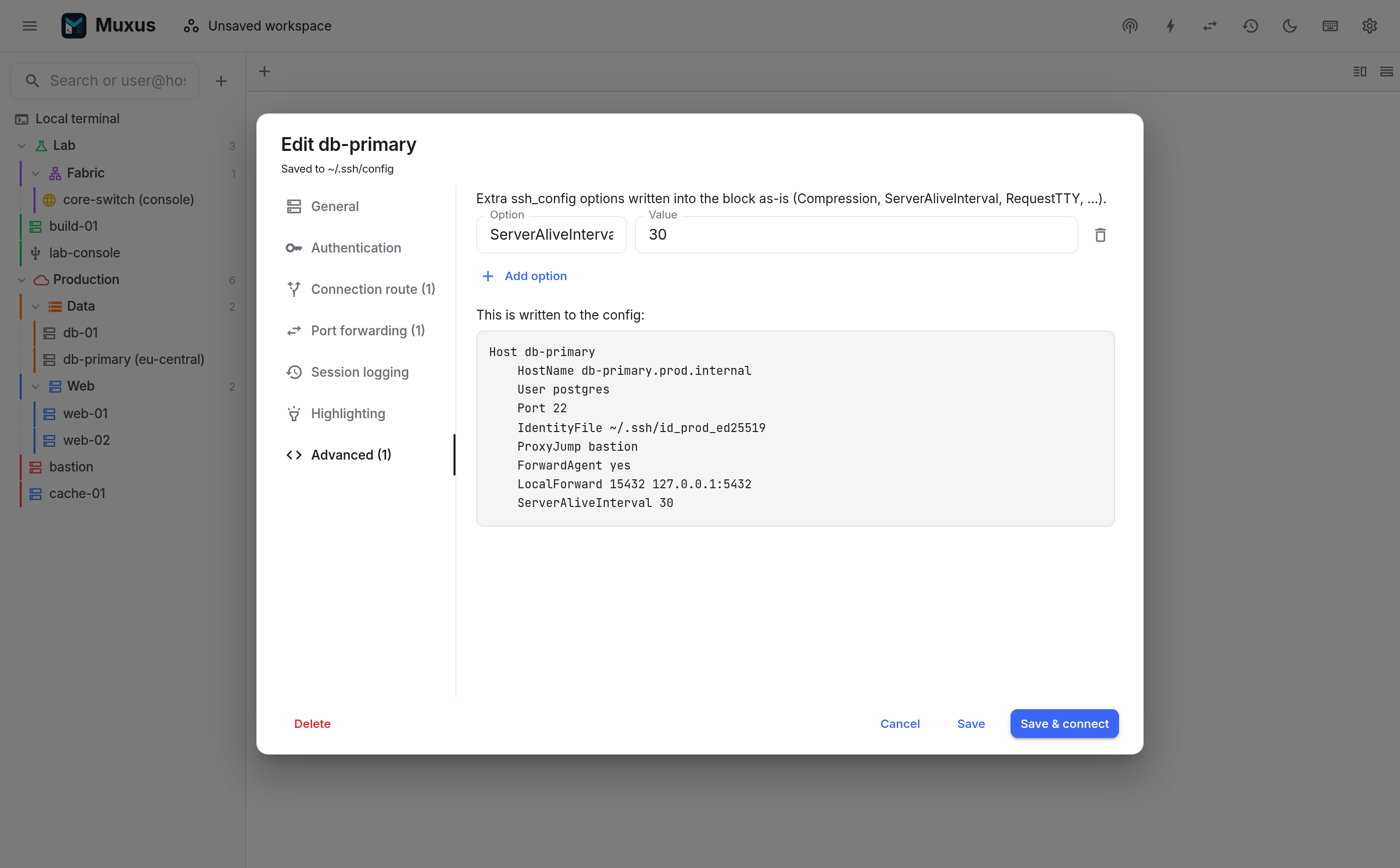
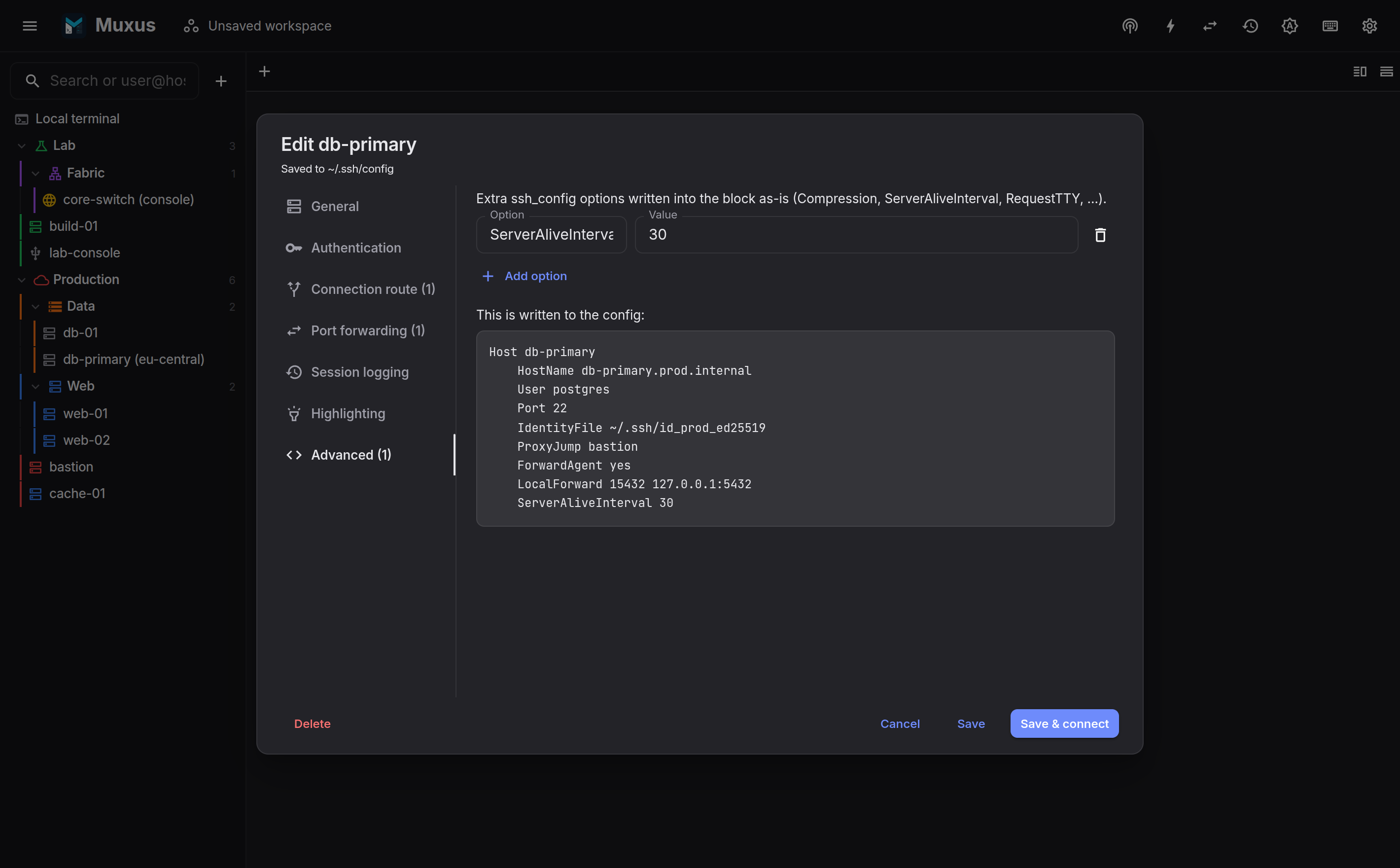
Any other keyword OpenSSH understands is entered here as free-form option/value pairs. The panel shows the exact block that will be written.
Saving
The footer offers Save and Save & connect. The second persists the selected storage type and opens a session immediately.
Duplicating a host keeps its storage type. Deleting an OpenSSH host removes only its block; deleting a Muxus-only host removes only its database profile.