Your hosts
The sidebar lists every concrete Host block in the OpenSSH configuration, including files
pulled in with Include, together with SSH, Telnet and serial hosts stored by Muxus.
Muxus does not import the configuration. It reads ~/.ssh/config directly and writes edits
back to the same file in place.
Import from MobaXterm
Open Settings → Backup & data → Import sessions to bring MobaXterm SSH bookmarks into
Muxus. On Windows, Find sessions reads bookmarks from the current user's local
MobaXterm installation. On every platform, you can choose MobaXterm.ini, .mxtsessions,
.mobaconf or a text export instead.
The review lists every detected SSH session. Choose whether SSH hosts should stay in Muxus
app data only or be written as OpenSSH Host blocks, then select which sessions to include
and whether matching hosts should be kept or replaced. Muxus
preserves the display name, host, port, username, password-vs-key authentication intent and
the SubRep folder hierarchy.
Passwords and private key files are not copied. Muxus uses your SSH agent or asks for credentials when you connect.
Import from SecureCRT
In SecureCRT, choose Tools → Export Settings, include Sessions, and save the XML export. Then open Settings → Backup & data → SecureCRT import in Muxus and choose that file. The review preserves nested folders, offers Muxus-only or OpenSSH storage for SSH sessions, and lets you select individual sessions or keep and replace matching hosts.
Muxus imports SSH names, hosts, ports, usernames and password-vs-key authentication intent. Serial sessions include their device path, baud rate, data bits, stop bits, parity and flow control. Local-shell sessions, incomplete entries and protocols Muxus cannot represent are listed as skipped.
Only connection metadata under the XML export's Sessions section is read. Encrypted
password fields, private-key paths, embedded files, scripts, terminal appearance and global
SecureCRT settings are never imported.
Host rows
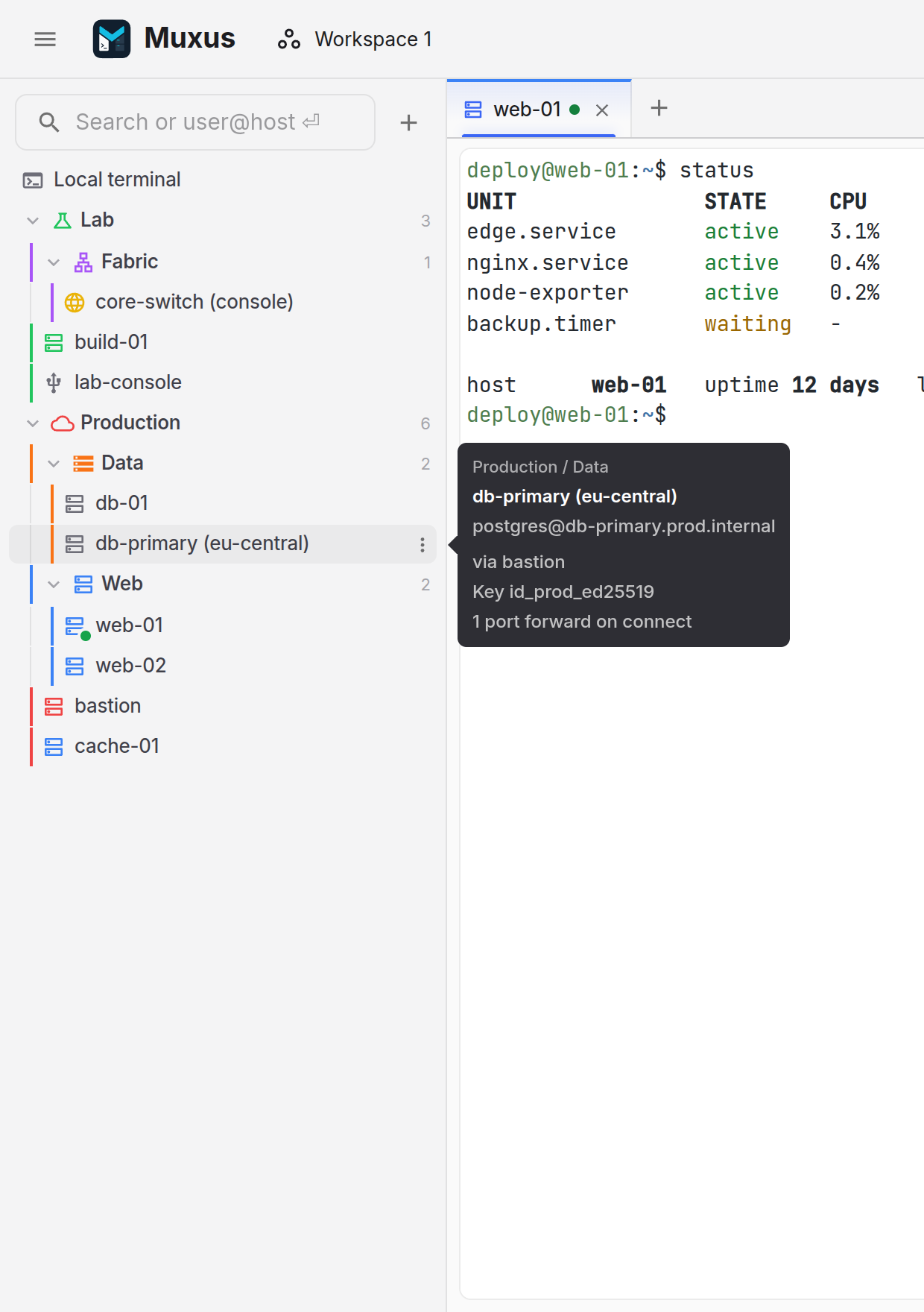
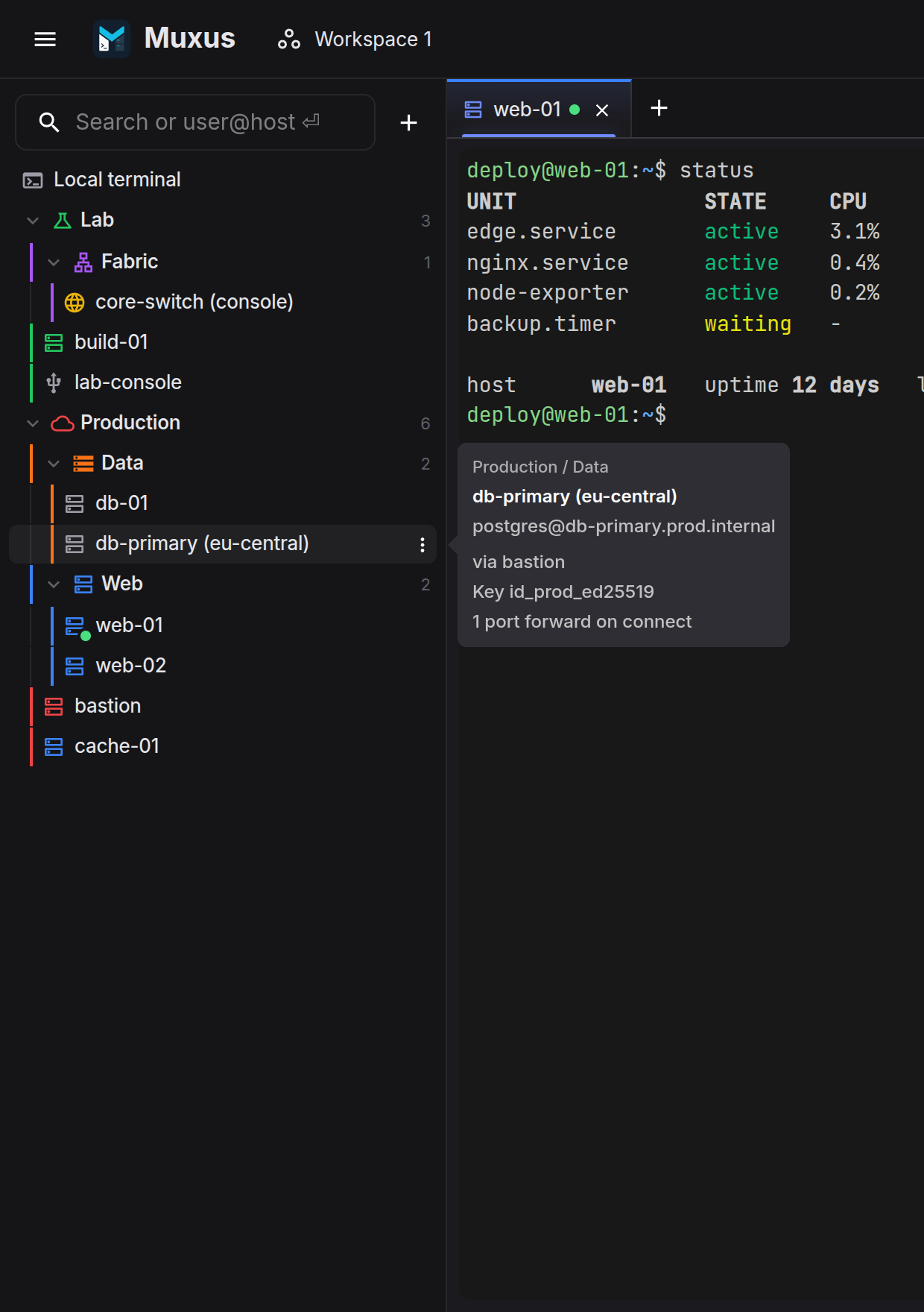
A row shows the host name, a host-kind icon (SSH, Telnet, serial), an optional colour flag, and a green dot while a session to that host is live, with a count when there is more than one.
The hover card carries the connection details:
- the address it resolves to (
user@hostname:port), - the jump chain, if the block has
ProxyJump, - the key that will be offered,
- password authentication when the block forces it,
- the number of port forwards started with the connection.
Click a row to connect. The right-click menu has Connect, Open in new window,
Move up/down, Move to folder…, Organize & color…, Edit host,
Duplicate, Copy ssh … command and Delete host.
Folders
Folders are stored in the local database next to the host colour, not in ssh_config.
Hosts without a folder are grouped by the file they were defined in.
- Create a folder by right-clicking empty space in the sidebar → New folder, or nest one inside another from a folder's menu.
- Fill it by dragging hosts in, or from a host's Move to folder….
- Style it with Rename, move & style…, which sets a colour and an icon (cloud, servers, storage, network, LAN, cluster, lock, lab, site).
- Reorder with drag & drop, or Alt+Up / Alt+Down on the focused row. Hosts keep the assigned order; folders sort alphabetically until moved.
- Collapse a folder and everything nested inside it in one action.
Deleting a folder does not delete hosts. They move up into the parent folder, and no connection setting changes.
Shared credentials
A folder can provide a default username, port, private key and password for every host inside it. Open Rename, move & style… and fill in the Shared SSH credentials section.
Precedence is always: the host's own settings first, then the nearest folder, then its
parents. OpenSSH-backed hosts also use anything resolved from ssh_config (including
Host * blocks) before consulting the folder. Muxus-only hosts do not read final-host
settings from ssh_config; only named ProxyJump hops can still resolve there. A folder
therefore fills gaps without replacing a value configured directly on the host.
The shared password is kept in the encrypted password vault and is tried automatically when a host falls back to password login; a password remembered for the host itself still wins. Folder credentials move with the folder when it is renamed or dragged, and deleting the folder deletes them.
Launching a folder
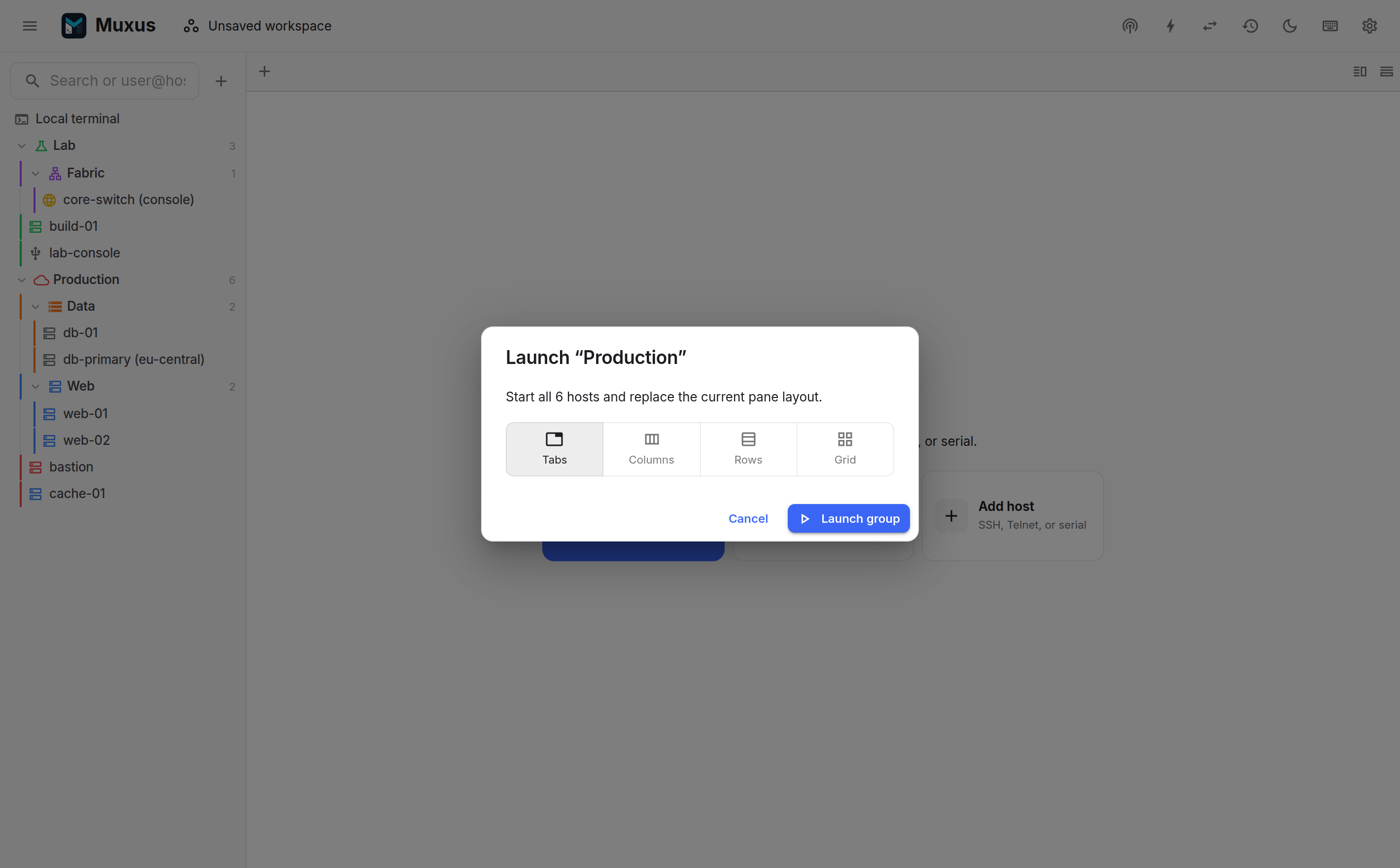
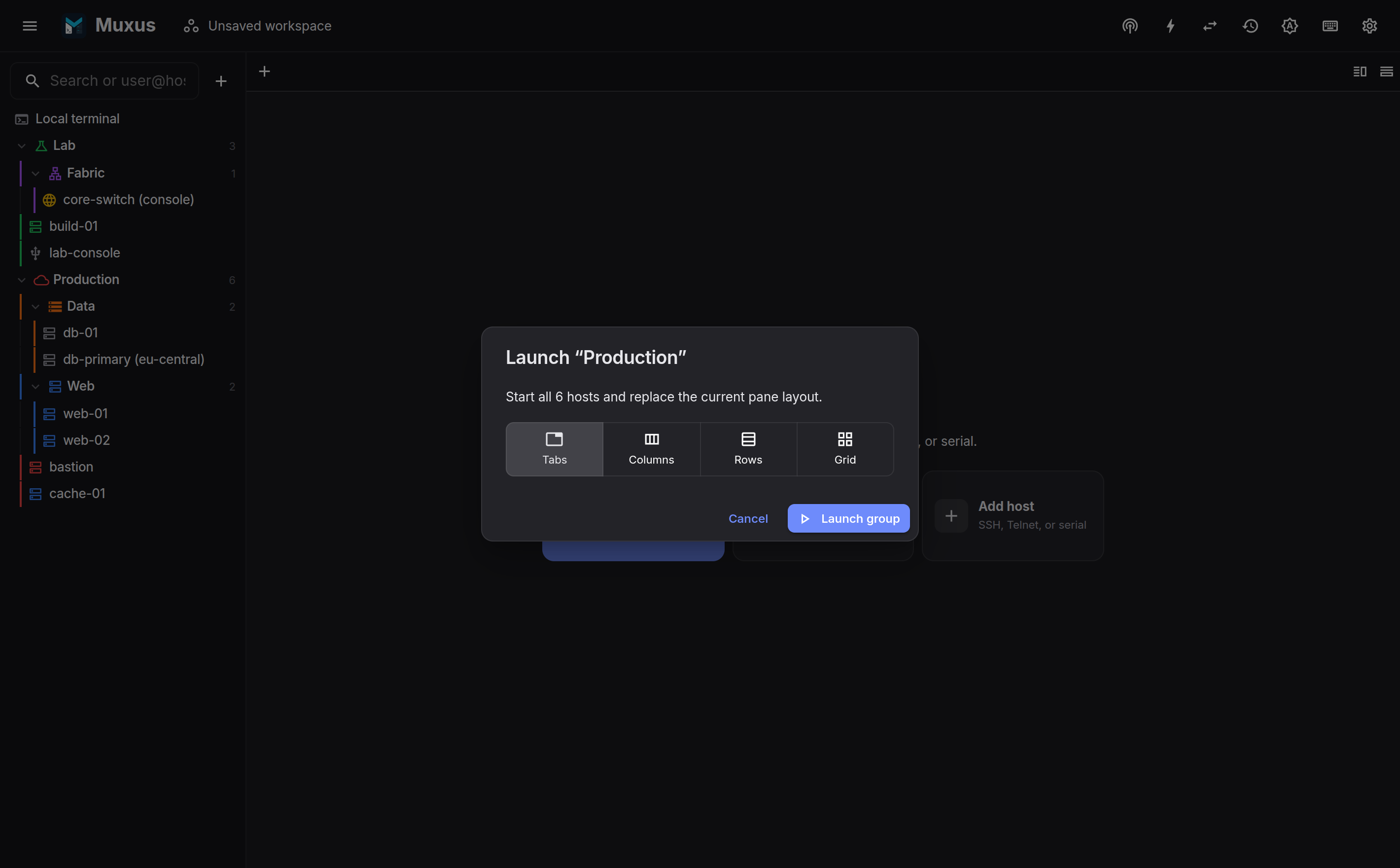
A folder's menu offers Launch n hosts…, which opens every host it contains, including nested folders, as tabs, columns, rows or a grid.
Search and quick connect
The box at the top of the sidebar both filters and connects.
Filtering is token-based: every whitespace-separated word must appear somewhere in the
host's searchable text (alias, hostname, user, description, display name or folder). af
tail matches MyAirframe1Tail inside the AF-Tails folder. Matching folders open while
you type and return to their previous collapse state when the box is cleared.
Enter connects to the highest-ranked match, which is highlighted in the tree. Ranking prefers an exact name over a prefix, a prefix over a substring, and a name match over an address or folder match.
Quick connect applies when nothing matches. Type user@host, host:port or
user@host:port and press Enter to dial it directly.
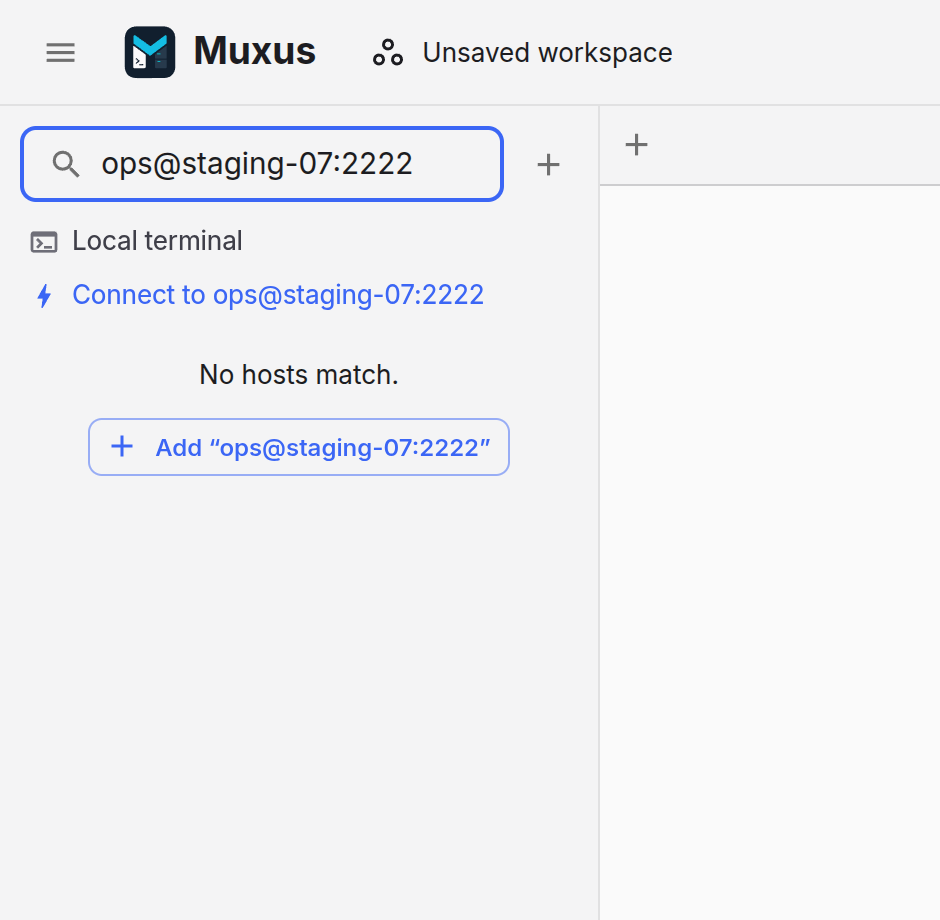
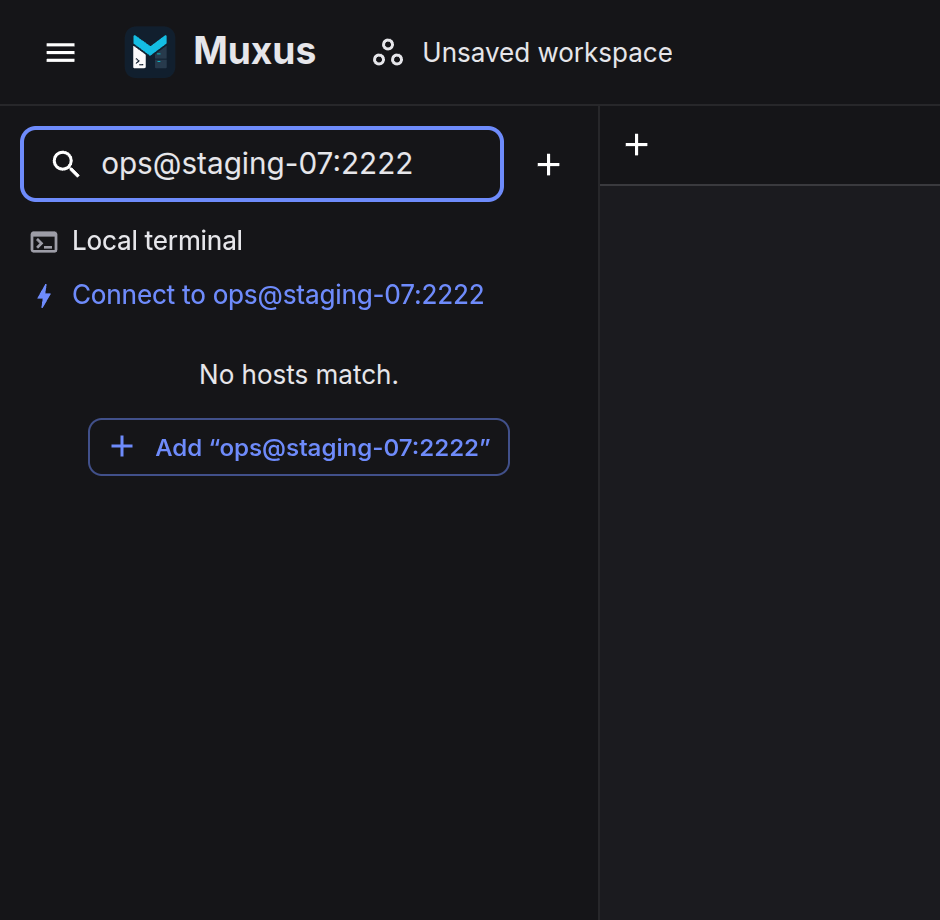
When a search matches nothing, the empty state offers to add what was typed, prefilled into the host editor.
Keyboard
The tree is a treeview. Down from the search box moves into it, arrows walk and
expand rows, Enter connects, Esc returns to the search box, and Alt+Up /
Alt+Down reorder the focused host or folder among its siblings.
Ctrl+B hides the sidebar. The quick launcher still reaches every host.
Local terminal
The first row is Local terminal, which opens a PTY running the login shell in a new
tab. The shell is configurable in settings; auto lets the server pick.