Settings
Settings are opened with Ctrl+, or the gear control in the top bar. Most changes apply immediately to open terminals. SSH keepalive changes apply on the next connection; session logging saves explicitly because storage policy should not change under a running recorder.
Appearance
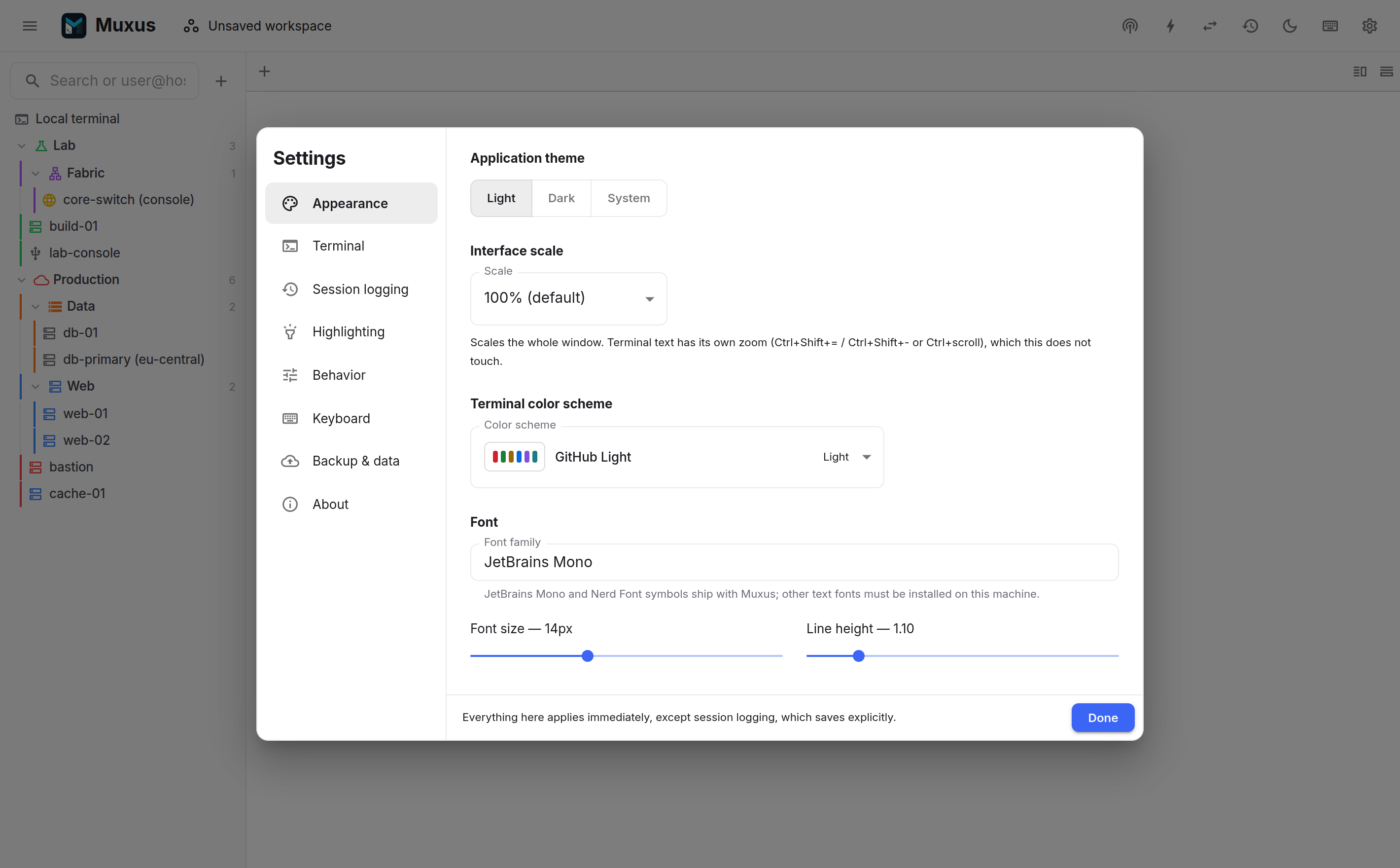
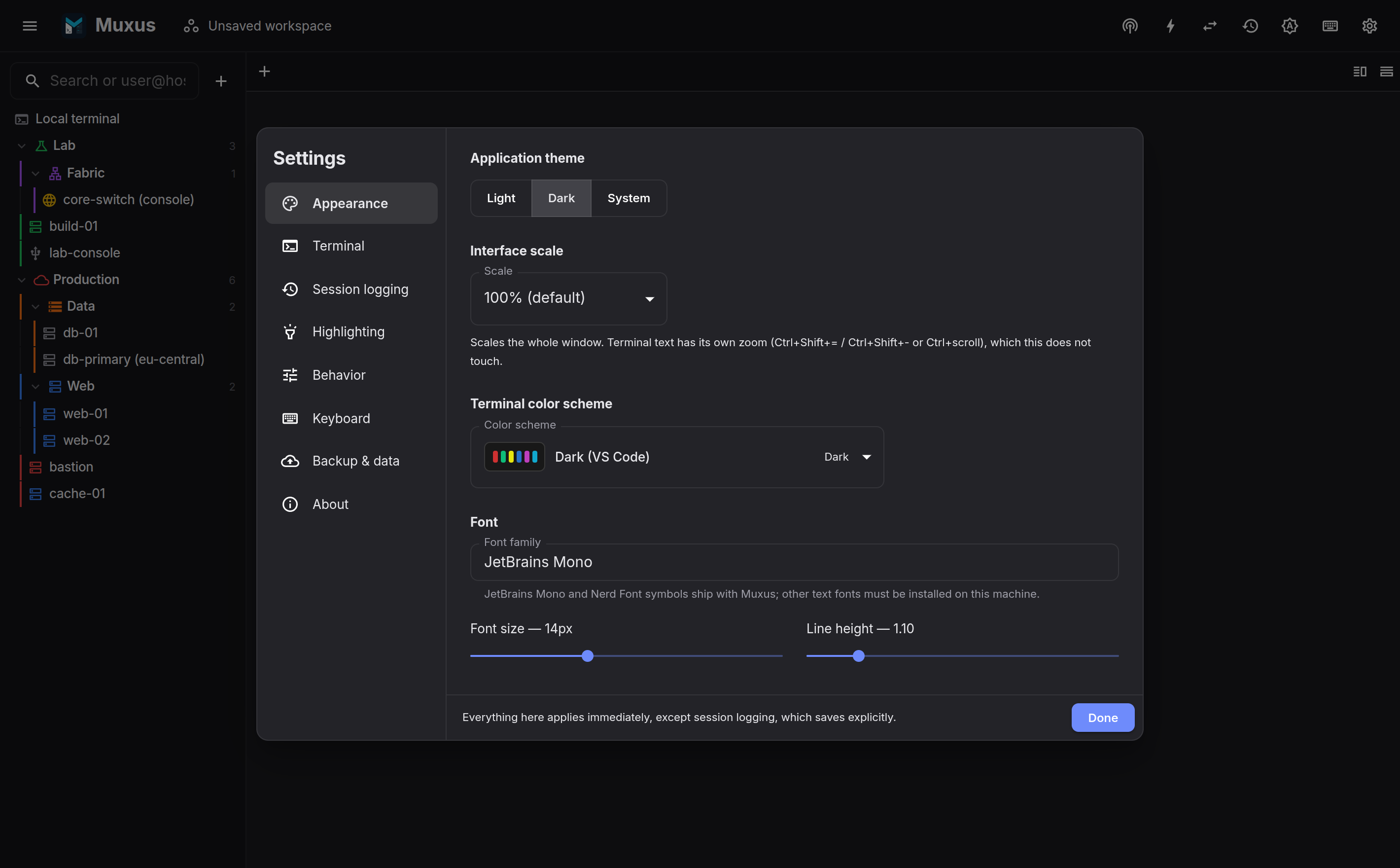
- Application theme: light, dark, or follow the system.
- Interface scale: the size of the whole window. Terminal text has a separate zoom (Ctrl+Shift+= / Ctrl+Shift+- / ++ctrl+wheel++).
- Split pane focus: dim inactive panes or add a thin theme-aware outline. Both are off by default; dimming starts at 15% and is adjustable. Multi-exec panes stay emphasized. These effects are presentation-only and do not alter terminal colours or output.
- Light terminal theme and Dark terminal theme: separate colour schemes that follow the effective application appearance, including system appearance changes. Fifteen schemes are grouped into light and dark sets, with optional shared text and background colour overrides.
- Font: family, size and line height. The desktop selector includes JetBrains Mono, which is bundled, plus the font families installed for the current operating-system user. Nerd Font symbols remain an automatic bundled fallback.
Terminal
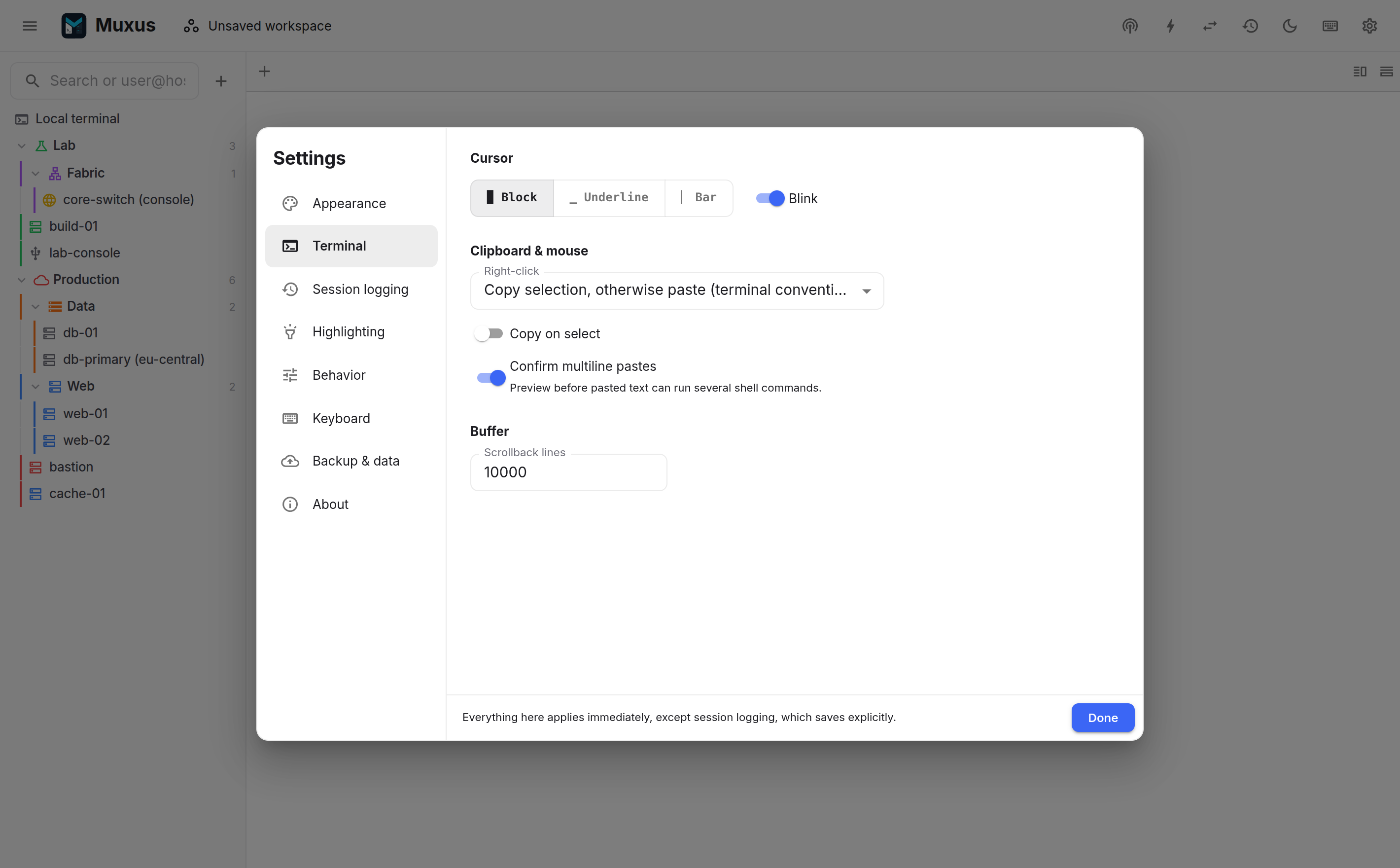
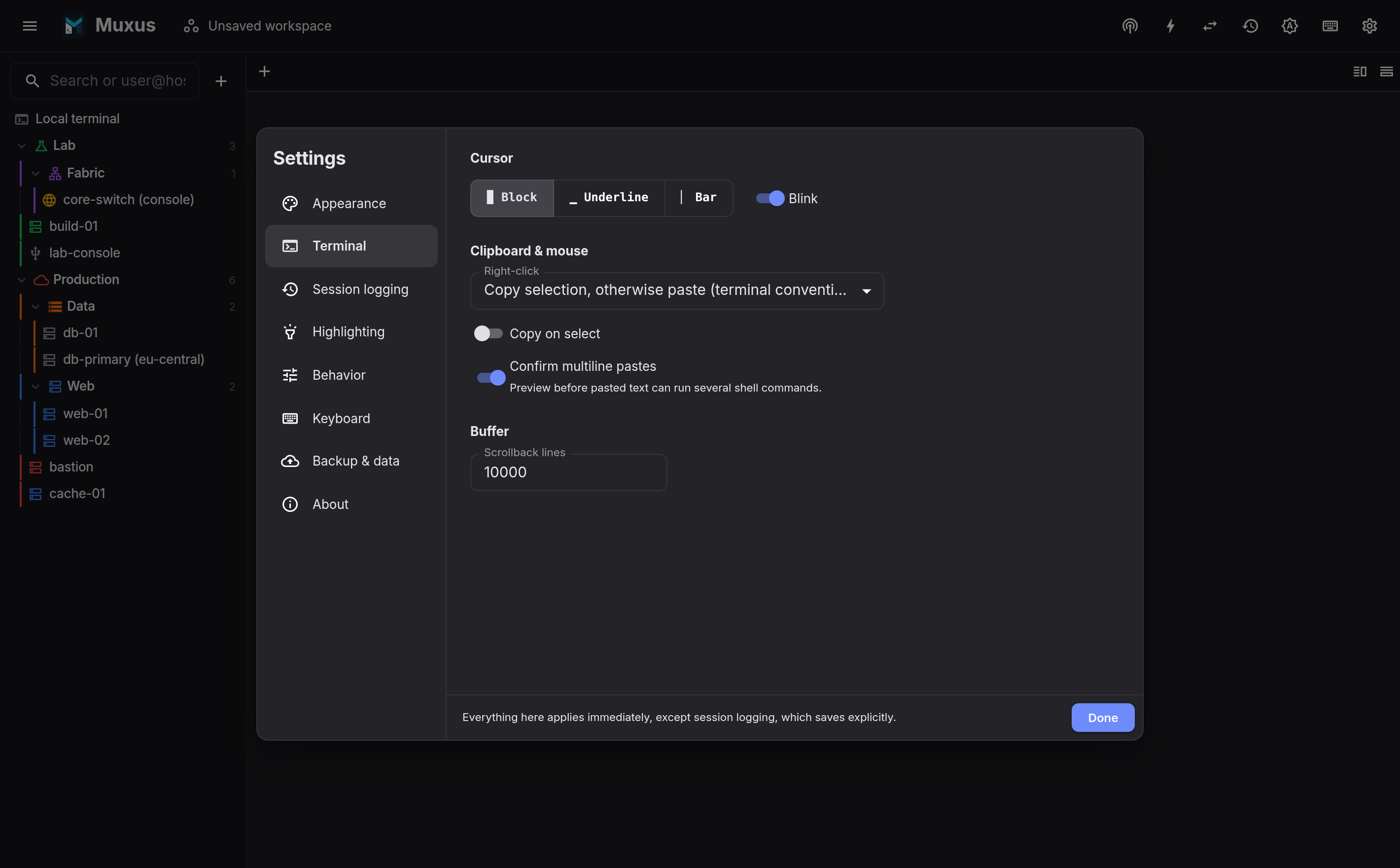
- Cursor: block, underline or bar, blinking or not.
- Right-click: copy-selection-otherwise-paste (the terminal convention), always paste, or a context menu.
- Open terminal links: choose Alt or direct left click on every platform, plus Ctrl on Linux and Windows or Cmd on macOS. The gesture applies to both file paths and web URLs. Alt + left click is the default so ordinary clicks and double-clicks remain available for terminal text selection.
- Copy on select, OSC 52 clipboard writes from terminal programs such as tmux and Zellij, and the multiline paste confirmation. OSC 52 reads remain blocked so a terminal program cannot retrieve the local clipboard.
- Scrollback lines kept per terminal.
Local shells
The automatic local terminal keeps the previous behaviour: auto uses the login shell,
or an executable can override it. Saved profiles make several local environments available
at once. Each profile has a display name, executable, structured argument list, starting
directory and optional startup commands.
Arguments are entered one per line, so a value containing spaces stays one argument. For
example, a Windows profile with executable wsl.exe and arguments -d and Ubuntu
opens that distribution; another profile can select Debian, PowerShell or cmd.exe.
Profiles appear below Local terminal in the sidebar and in the quick launcher. One can
be selected as the default used by the sidebar, empty-pane shortcut and generic local
terminal action. Startup commands are entered into the interactive shell whenever the
profile starts, including when it is restored in a workspace.
Session logging
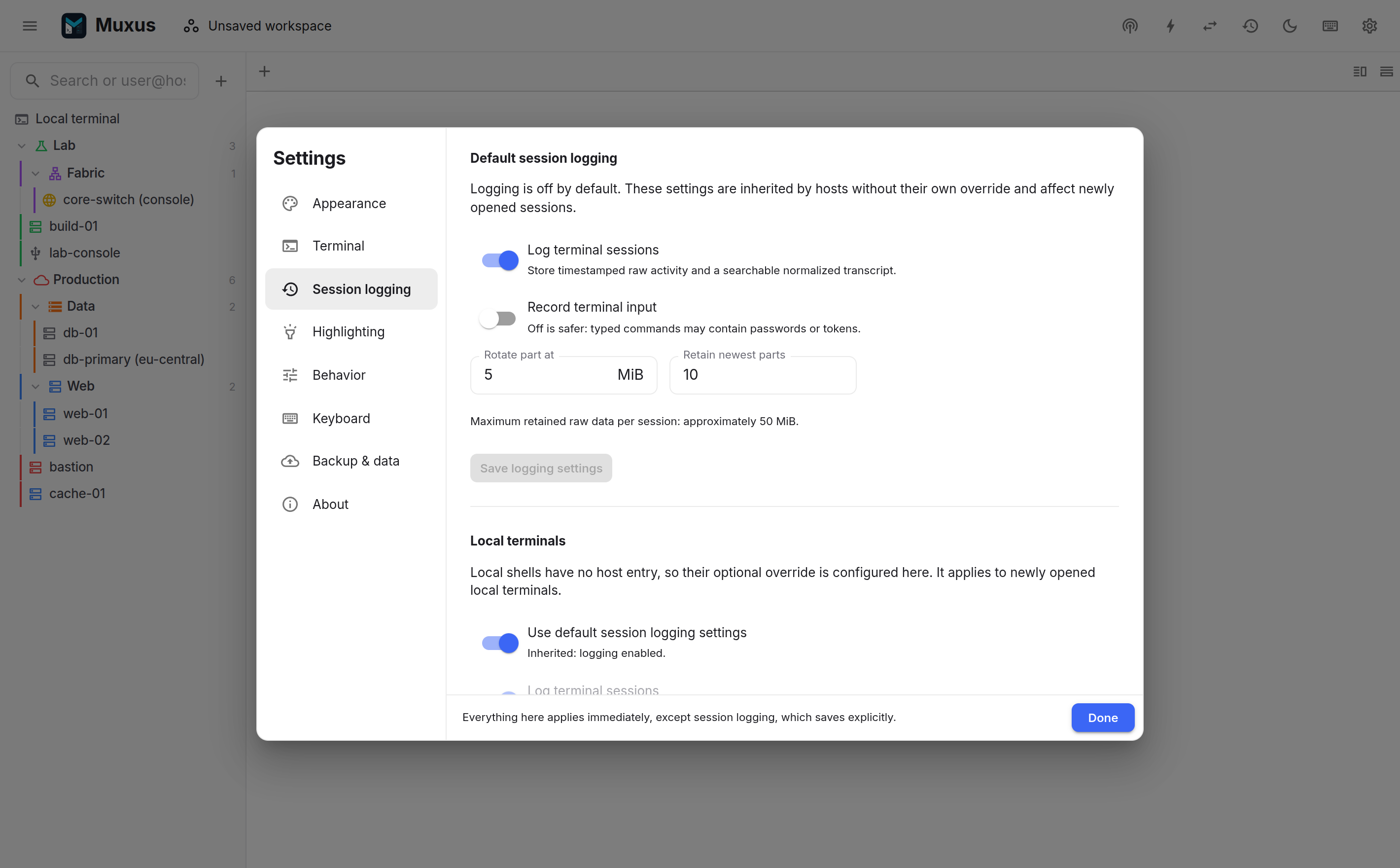
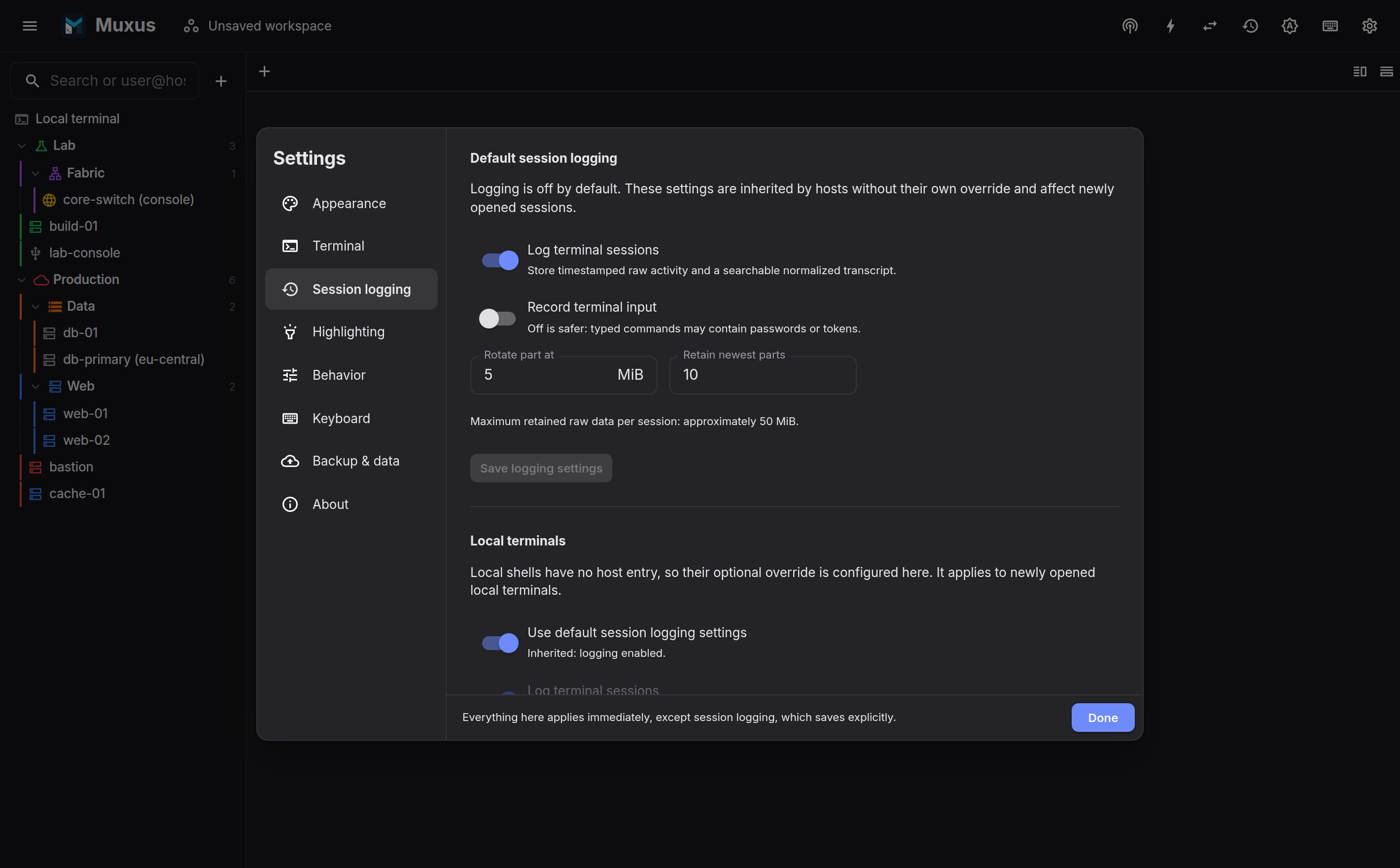
Off by default. This section enables retention globally, controls whether input is captured, and sets the storage policy: location, maximum total size, minimum free space (absolute and percentage), maximum age, and the number of parts each session keeps. Current usage against the quota is displayed here.
Highlighting
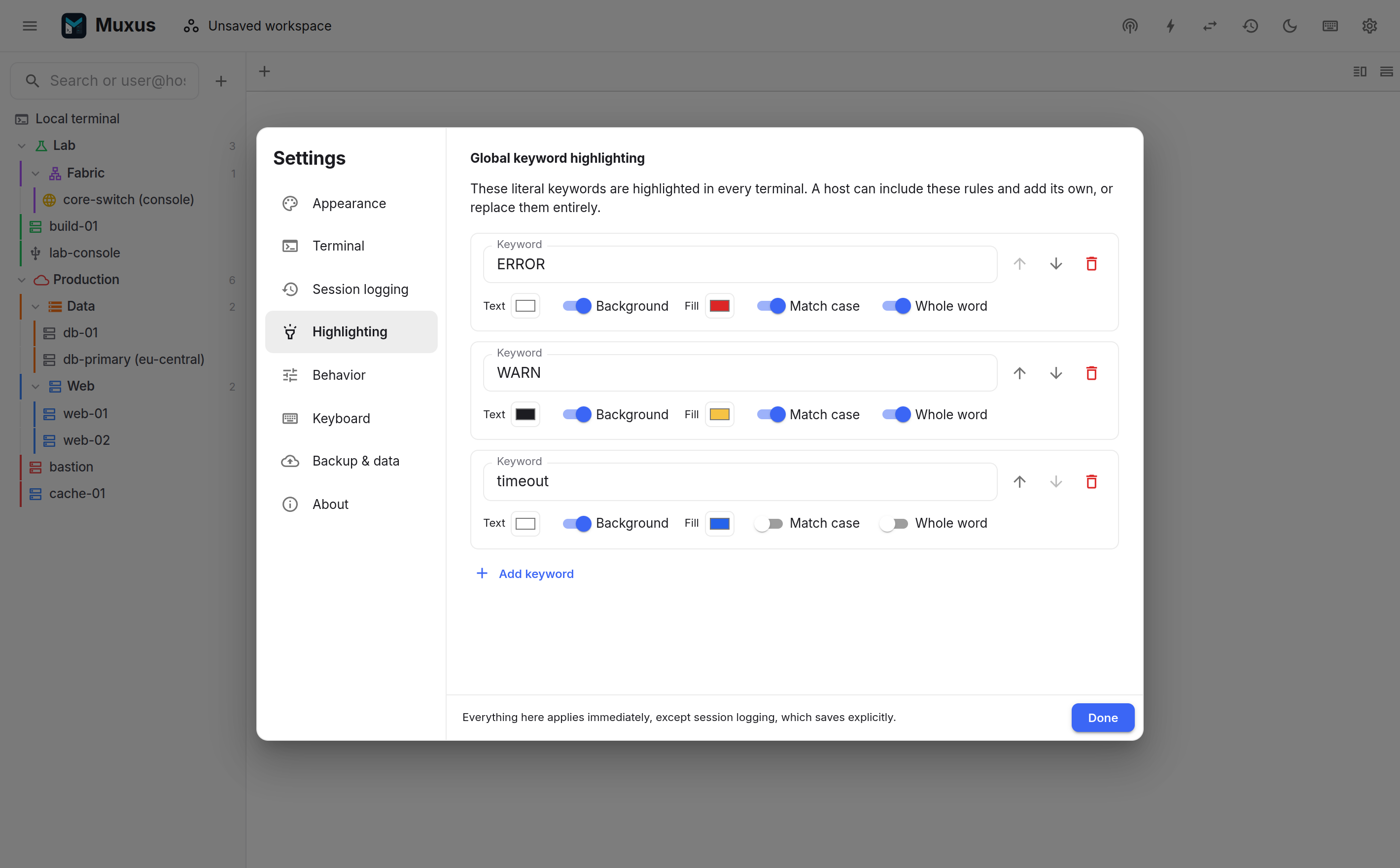
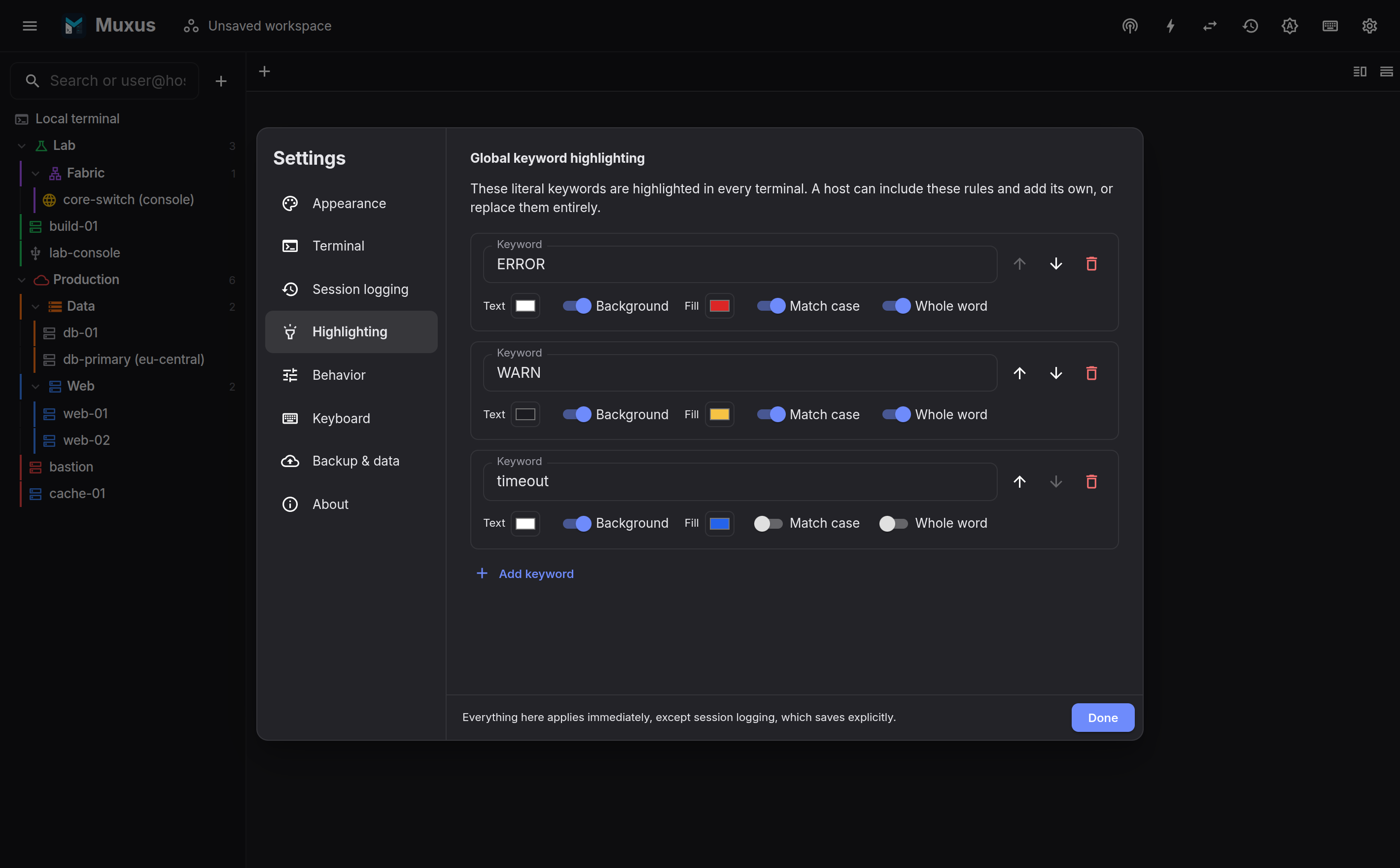
Global keyword rules apply to every terminal: keyword, foreground, optional background, case sensitivity and whole-word matching. Reusable profiles keep named, platform-specific rule sets that can be assigned to several SSH, Telnet or serial hosts. Profiles have stable IDs and can be imported or exported as JSON, so importing an updated copy refreshes existing assignments. Hosts can add their own rules and choose whether to include the global set.
Behavior
Confirm before closing a live session is on by default because closing a connected tab ends its shell.
SSH keepalive interval defaults to 30 seconds. It sends a protocol-level probe while an
SSH connection is idle so firewalls, NATs and VPNs do not silently discard it. An explicit
ServerAliveInterval in the host's OpenSSH configuration takes precedence; choose SSH
configuration only to disable the Muxus fallback. A changed interval applies when a
connection is dialed fresh; tabs that share an existing transport keep its keepalive until
it is replaced, for example by Force reconnect all in the workspace dialog.
The two restore switches are also on by default. Automatically reconnect remote sessions dials remote tabs when restoring a workspace and retries a dropped connection a few times. Turn it off to restore remote tabs without logging in. Restore terminal history saves recent output locally every few seconds and replays it above the new session after a restore or reconnect.
Keyboard
Controls whether new splits continue the current session (on by default; SSH reuses the live connection, and serial always asks), whether window-wide tab numbers appear while Alt is held or always, a summary of the layout keys, and access to the full shortcut editor.
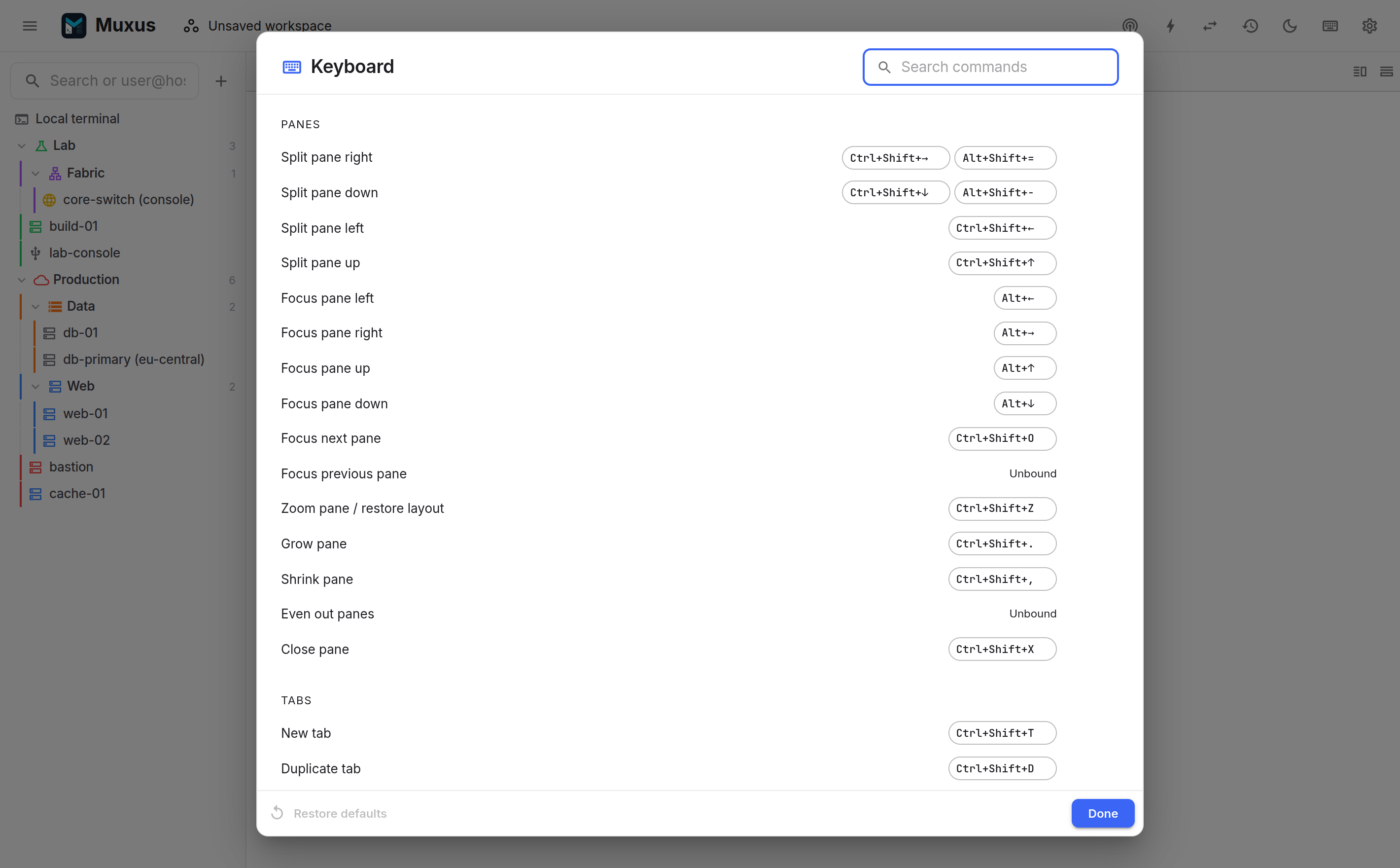
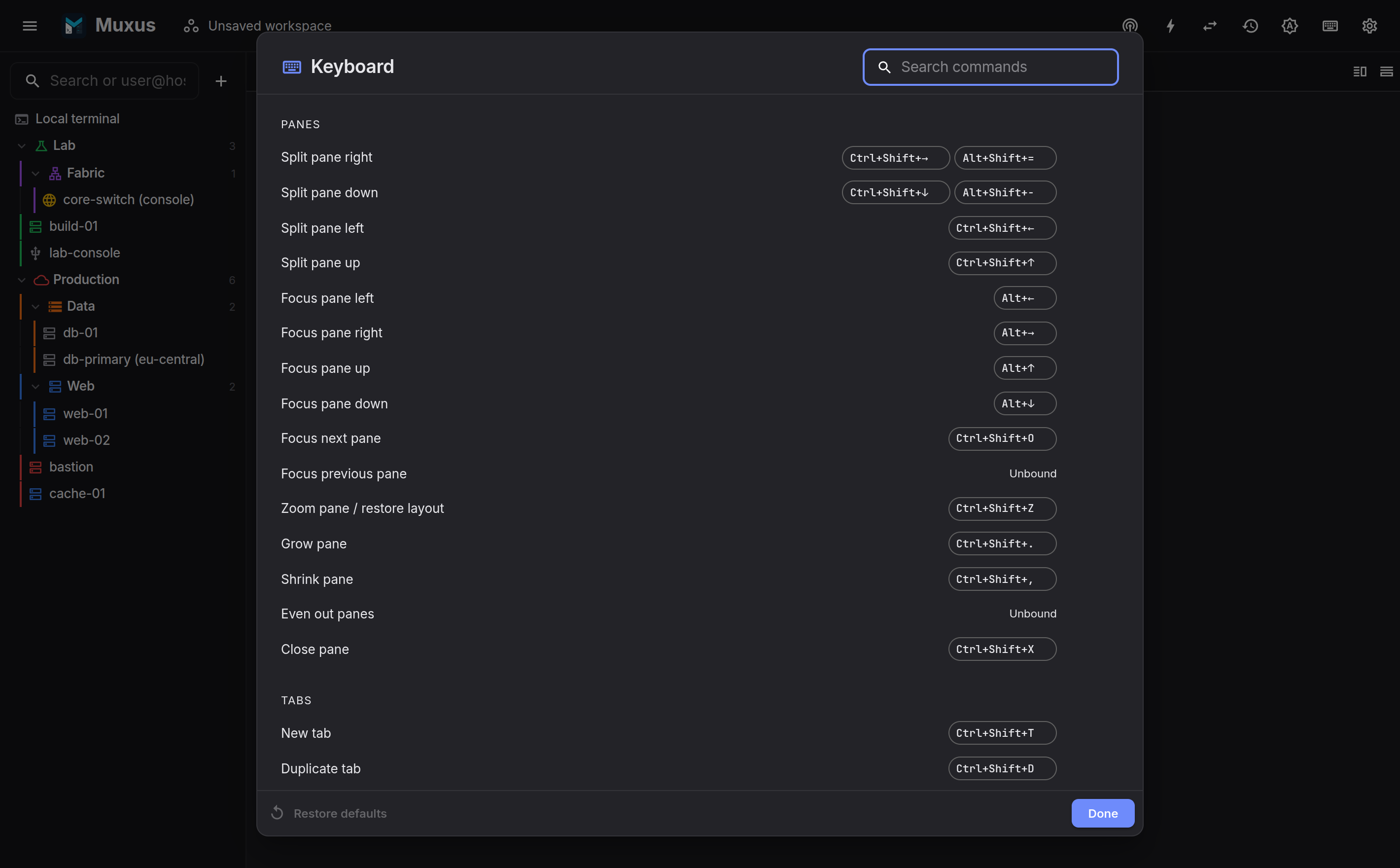
All commands share one keymap. A chord is recorded by pressing it, a command can carry a second chord, and defaults are restored in one click. The sheet is also reachable with Ctrl+Shift+/.
Passwords
The password vault is optional. New vaults default to the never-prompt policy, which uses the operating-system credential store.
- Create password vault sets a master password of at least 8 characters.
- Change prompt policy chooses when routine SSH use needs the master password: Never for saved credentials stores the vault key in the OS credential store, When Muxus starts unlocks it into memory once, and Whenever a saved credential is needed prompts for each use.
- View or edit password asks for the master password before revealing the saved value.
- Change master password changes that management password without rewriting every credential.
- Restore OS access appears if the never-prompt policy is selected but the credential store entry is missing.
- Saved-password rows can be forgotten individually. Delete vault forgets all of them without removing hosts, keys or other settings. Reset intentionally needs no master password, so a forgotten password cannot make the vault impossible to remove.
The master password cannot be recovered. Saved-password ciphertext is local to the application database and is not included in Muxus backups. The raw vault key is never stored in the application-data directory.
Backup & data
Create backup writes the Muxus-side data to a file: folders, colours, saved Telnet/serial hosts, workspaces, tunnels and preferences. Restore a backup merges a file back in; items absent from the file are not deleted.
Export OpenSSH writes the SSH hosts out as a standard ssh_config for use with another
client. Non-secret shared folder defaults are copied into each affected host block so the
export remains usable outside Muxus. Folder and host passwords are omitted; other
Muxus-only settings remain in the backup.
What a backup excludes
Private key files, passwords and recorded session history are never part of a backup.
A backup can contain a saved SSH ProxyCommand. Restoring it does not run the command,
but opening that connection later does. Restore backups only from sources you trust.
Debug
Debug mode raises the app's logging to connection-level detail: every dial, each authentication method as it is tried, waits on the SSH agent, host key verification, and the raw error behind a failed connection. Warnings and errors are always captured, even while debug mode is off. A failure can therefore be inspected after the fact. Turn on debug mode only when the next attempt needs verbose detail.
View logs opens a live viewer with level and text filters; Export logs saves everything as a text file. Logs live in a small, bounded in-memory buffer on this machine. They reset when the app quits and are never written to disk or sent anywhere unless exported.
When the app will not start
The desktop shell also writes startup milestones and crashes to logs/main.log in
its application-data directory (for example ~/.config/Muxus on Linux,
~/Library/Application Support/Muxus on macOS, %APPDATA%\Muxus on Windows).
A failed launch shows a dialog pointing at this file.
About
Version and platform information, a link to the source repository, and a manual update check. When a newer release exists, Muxus links to its GitHub release so the appropriate installer can be downloaded.