Tunnels & port forwarding
The forwarding panel is the control in the top bar, badged with the number of active forwards. It has two sections: persistent tunnels that have been saved, and the forwards running on each live connection.
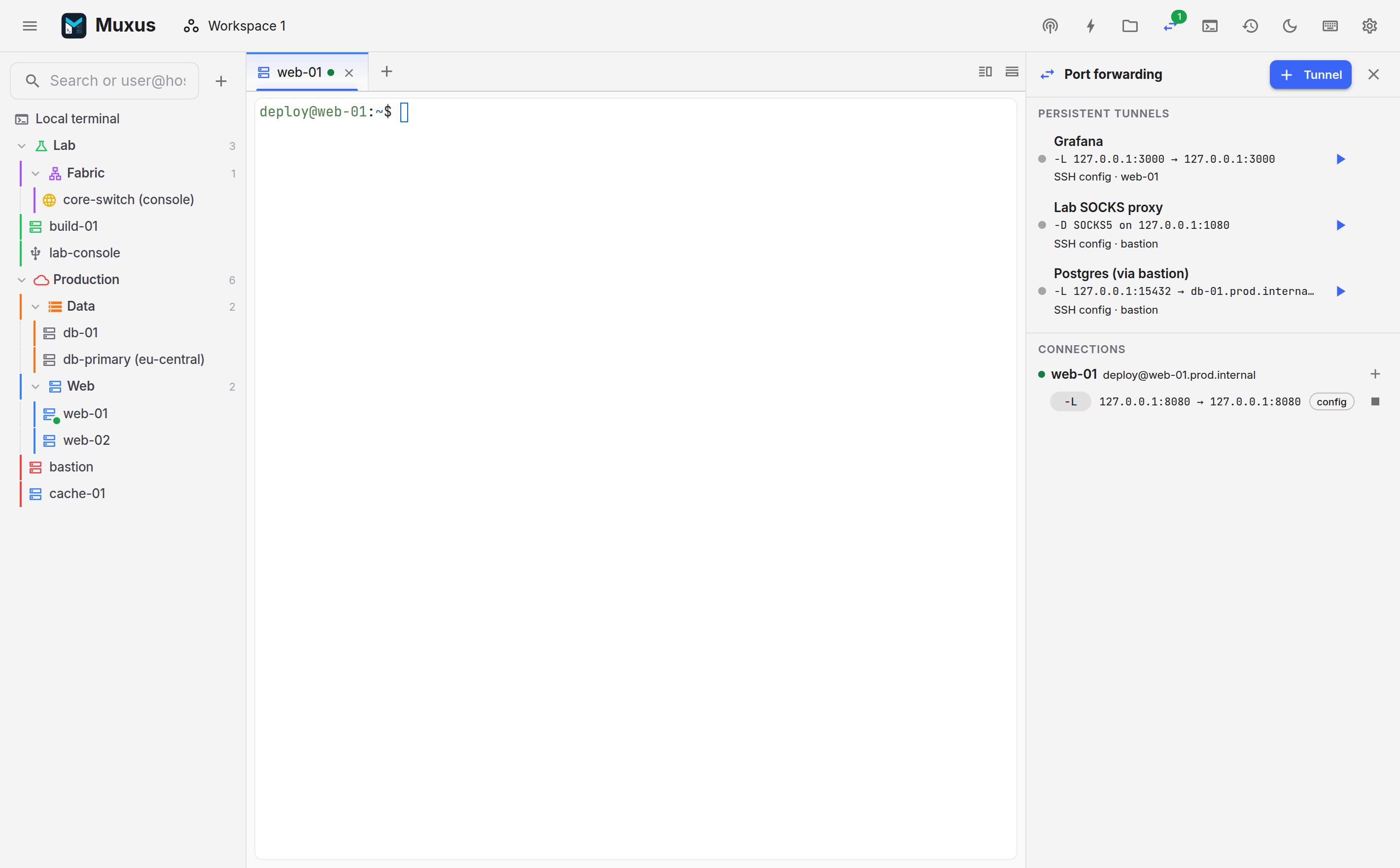
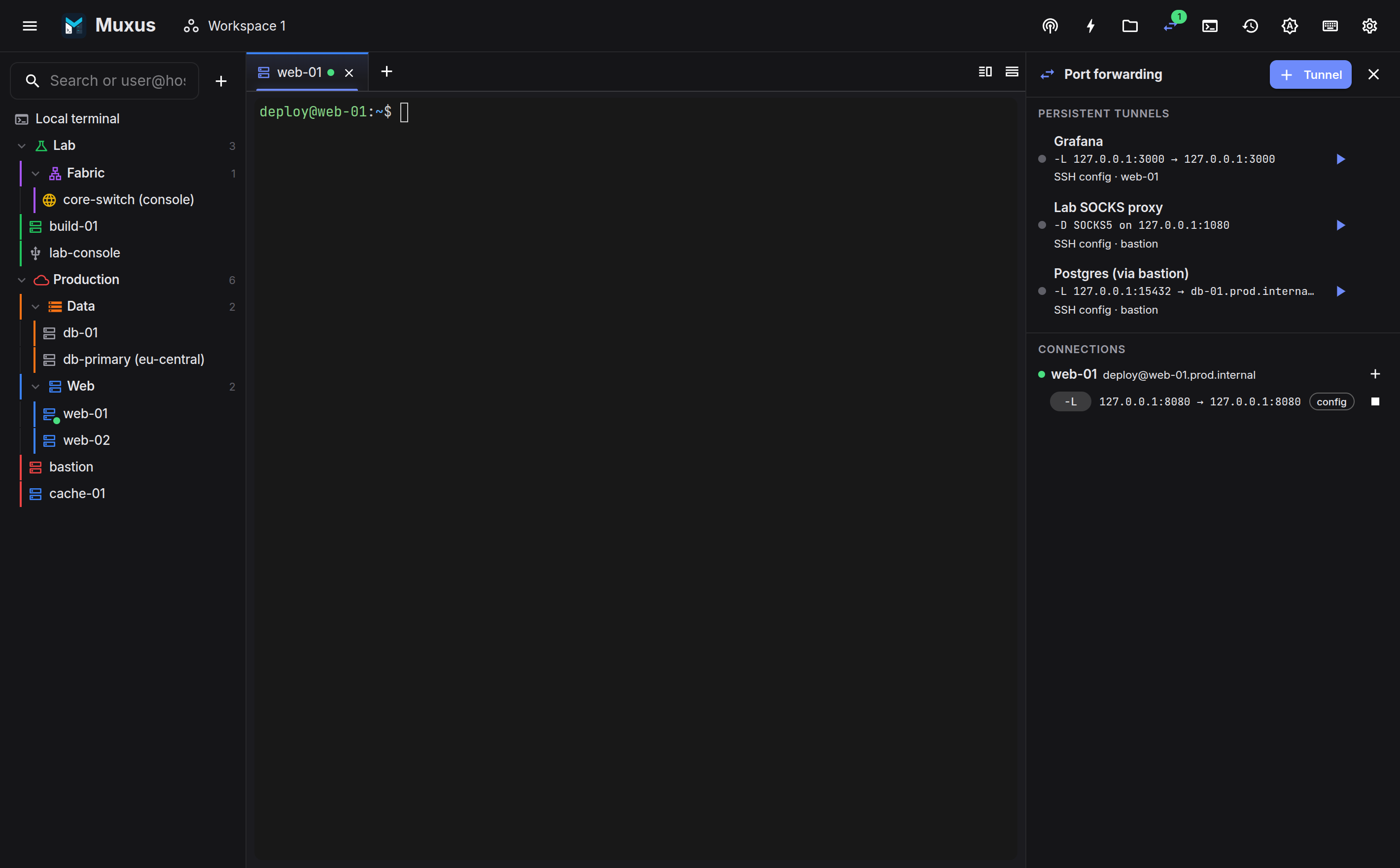
Persistent tunnels
A saved tunnel consists of a name, a target host and a rule. Starting it with runs it without a terminal. Muxus reuses a live connection to that host if one exists, or dials a shell-less transport with the full interactive authentication flow: host-key check, key passphrase and 2FA prompt.
| Type | Flag | What it does |
|---|---|---|
| Local | -L |
A port on the local machine reaches a host and port on the far side |
| Remote | -R |
A port on the remote reaches a local target |
| Dynamic | -D |
A local SOCKS5 proxy through the remote |
Tunnels hold their own transport lease, so closing every terminal to that host does not stop the tunnel.
Forwards on a live connection
The lower section lists each connected host and the forwards running on it:
config-badged forwards come from the host'sLocalForward,RemoteForwardorDynamicForwardlines. They start and stop with the session. Stopping one manually affects only the current session; the configuration rule is unchanged.- Ad-hoc forwards are those started from the panel with +. Two actions make them
durable:
- Save as tunnel moves it into the persistent list, so it can be started later without a terminal;
- Save to ssh config writes it into that host's
Hostblock, so every future connection starts it, including fromsshon the command line.
Adding a forward
Use + Tunnel in the panel header, or + on a live connection. Both require a bind port, a target host and a target port, and the host editor's diagram shows the resulting direction.
Choosing between the two
- A forward needed while working on that host belongs on the host, so it starts with the session.
- A forward needed independently of a terminal session, such as one used by a database GUI or a browser, belongs in the persistent tunnel list.
Reaching a tunnel
Bindings are on 127.0.0.1. A local forward on port 3000 is reachable at
http://127.0.0.1:3000. A dynamic forward on 1080 is a SOCKS5 proxy at 127.0.0.1:1080,
usable from a browser's proxy settings or curl --socks5-hostname.
Tunnels are also reachable from the quick launcher: press Ctrl+K, type the name, and the tunnel starts or stops in place.